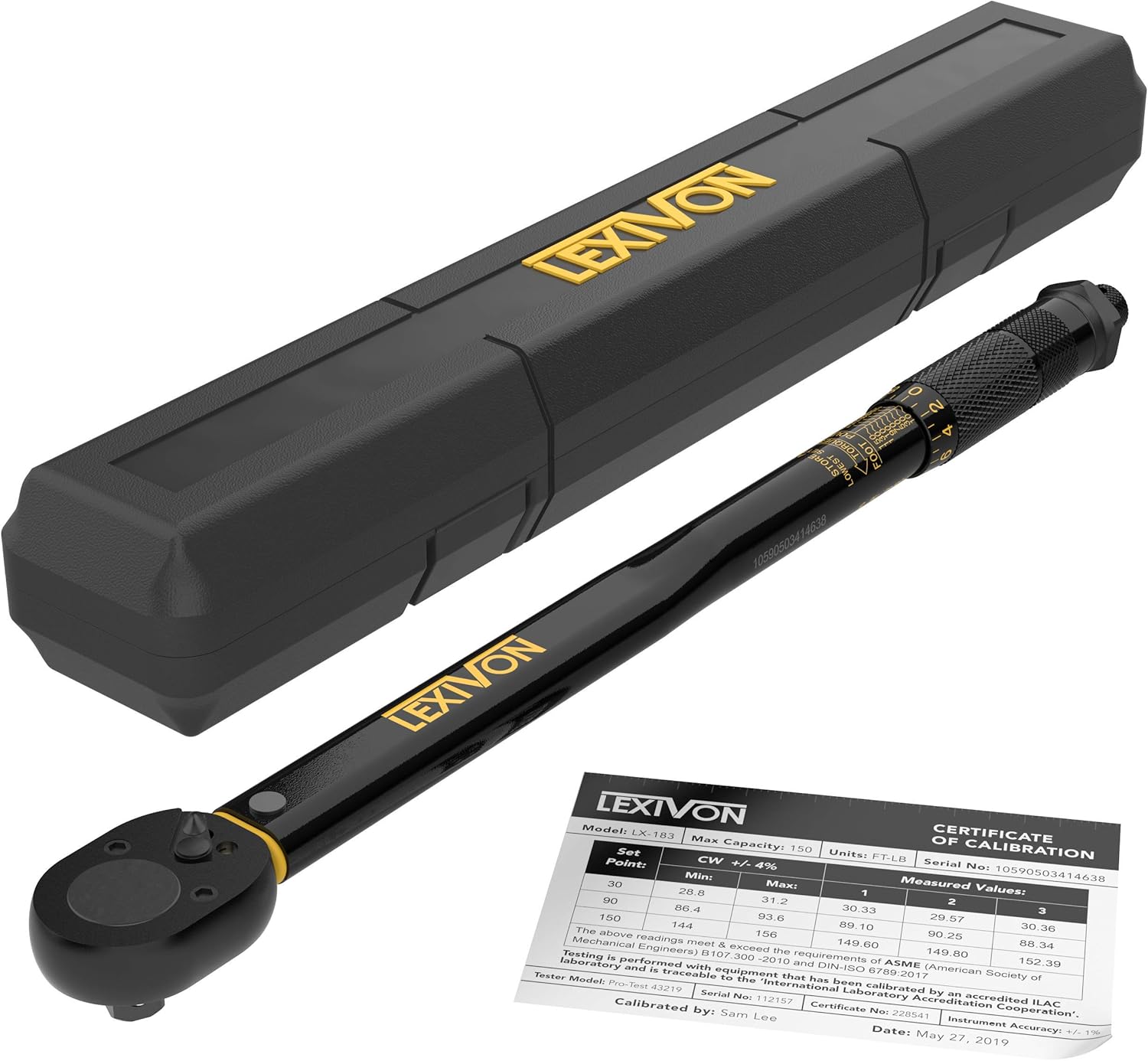
If you’re looking for the best torque wrench for home mechanic work, my short answer is the LEXIVON LX-183 1/2-Inch Click Torque Wrench — it covers the 10–150 ft-lb range that handles almost every job on a sedan, SUV, or light truck, and its owner ratings are about as close to unanimous as Amazon gets. I’ve torqued hundreds of lug nuts, brake caliper bolts, and drain plugs over the years, and a good click wrench is the one tool that separates “probably tight enough” from “tightened to spec.” This guide covers seven wrenches I’d trust in a home garage, from a $22 beam wrench to a pro-grade 250 ft-lb micrometer model, plus the honest complaints real owners keep posting.
As an Amazon Associate, Top10Great earns from qualifying purchases. This post contains affiliate links, which means we may receive a commission if you buy through our links, at no extra cost to you.
Torque Wrench Comparison Table
| Product | Best For | Key Spec | Price | Link |
|---|---|---|---|---|
| LEXIVON LX-183 | Best Overall | 1/2″ drive, 10–150 ft-lb, ±4% | $$ | Check price |
| EPAuto 1/2″ Click | Best Budget | 1/2″ drive, 10–150 ft-lb, loud click | $ | Check price |
| GEARWRENCH 85066 | Best Premium | 1/2″ drive, 30–250 ft-lb micrometer | $$$ | Check price |
| TEKTON 24335 | Best All-Steel Value | 1/2″ drive, 10–150 ft-lb, no plastic parts | $$ | Check price |
| ACDelco ARM601-4 | Best Digital | 1/2″ drive, 14.8–147.5 ft-lb, LCD + buzzer | $$ | Check price |
| LEXIVON LX-184 | Trucks & Big SUVs | 1/2″ drive, 25–250 ft-lb | $$ | Check price |
| Tooluxe 03703L Beam | Cheapest / Never Needs Calibration | 3/8″ + 1/2″ dual drive, 0–150 ft-lb | $ | Check price |
Best Overall: LEXIVON LX-183 1/2-Inch Click Torque Wrench
The LX-183 is the wrench I recommend when someone asks me which single torque wrench to buy first. It’s a 1/2-inch drive click wrench with a 10–150 ft-lb range, which covers lug nuts (typically 80–110 ft-lb), brake caliper brackets, suspension bolts, and most drain plugs. The chrome-moly steel build feels more expensive than it is, and the black finish with bright yellow scale markings is dramatically easier to read than the faint stampings on most budget wrenches — a real advantage when you’re setting torque under a car with a work light.
The numbers back it up: roughly 33,000 Amazon ratings with about 92% at four or five stars. Owners consistently describe it as accurate out of the box and simple to set, and it comes in a proper storage case.
Pros: ideal 10–150 ft-lb range for car and SUV work; high-contrast, easy-to-read scale; ratchets in both directions; includes storage case and calibration certificate.
Cons: at 17 inches, some owners wish the handle were longer for high-torque lug nuts; several reviewers note the black finish scratches easily if you set it down on concrete. It also only measures torque clockwise, like most click wrenches in this class.
Who should buy it: anyone who wants one dependable wrench for tire rotations, brakes, and general maintenance. Check the current price on Amazon.
Best Budget: EPAuto 1/2-Inch Drive Click Torque Wrench
Usually selling in the low-to-mid $30s, the EPAuto is the value pick for occasional use. Same 10–150 ft-lb range as the LEXIVON, pre-calibrated to ±4%, with a click reviewers repeatedly describe as loud and unmistakable — you will not blow past your setting because you missed the cue. It comes with a hard case, and EPAuto’s customer service gets called out positively in reviews.
Pros: excellent price for a calibrated tool; loud, clear click; full 10–150 ft-lb range; storage case included.
Cons: the handle is on the short side, so 100+ ft-lb lug nuts take real effort; the printed scale markings are light and hard to read in dim garages — one owner even reported brake cleaner wiping the markings off entirely.
Who should buy it: the DIYer who torques lug nuts a few times a year and wants accuracy without spending more than necessary. Check the current price on Amazon.
Best Premium: GEARWRENCH 85066 Micrometer Torque Wrench
The GEARWRENCH 85066 is a professional-grade micrometer click wrench with a 30–250 ft-lb range — the one to buy if your garage includes a full-size truck, or if you want a tool that survives daily use. Owners praise the build quality and longevity, and it’s the kind of wrench that costs half of what a tool-truck brand charges while doing the same job. The higher ceiling matters for trailer hitches, axle nuts, and truck lug nuts that spec well above 150 ft-lb.
Pros: 250 ft-lb capacity handles trucks and heavy suspension work; durable pro-grade construction; long handle gives you the leverage high settings require; smooth, precise micrometer adjustment.
Cons: the 30 ft-lb floor is too high for small fasteners like valve covers or oil pan bolts, so you’d still need a 3/8-inch wrench for light work; it costs roughly three times as much as the budget picks.
Who should buy it: serious home mechanics and truck owners who will use it often enough to justify the spend. Check the current price on Amazon.
Best All-Steel Value: TEKTON 24335 1/2-Inch Click Torque Wrench
TEKTON has built a reputation as arguably the best value in hand tools for home mechanics, and the 24335 shows why: all-steel construction with no plastic parts to break, a 10–150 ft-lb range, ±4% accuracy, and a lifetime warranty backed by responsive US-based customer service. Owners who’ve tested it against far more expensive wrenches report matching accuracy. It ships with an exploded-view diagram and a QR-linked video explainer, which beginners appreciate.
Pros: all-metal build, nothing to crack or wear out; lifetime warranty; proven accuracy at a fair price; reversible ratchet head.
Cons: multiple reviewers say the click is faint at low torque settings (under roughly 25 ft-lb), so go slowly on small fasteners; the etched scale markings can be hard to read in poor light.
Who should buy it: anyone who values durability and warranty support over frills. Check the current price on Amazon.
Best Digital: ACDelco ARM601-4 Digital Torque Wrench
If you’d rather read a number than interpret a click, the ACDelco ARM601-4 puts torque on an LCD screen and warns you with a buzzer and LED flash as you approach your target. The 14.8–147.5 ft-lb range covers standard car and SUV work, it converts between ft-lb, Nm, in-lb, and kg-cm at the press of a button, and each unit ships individually serialized with a NIST-traceable certificate of calibration — unusual rigor at this price.
Pros: exact digital readout removes guesswork; buzzer plus LED warning before you hit the target; four unit conversions for metric and imperial specs; ISO 6789 calibration certificate included.
Cons: it runs on batteries, which will inevitably be dead the day you need it; some owners find the buzzer easy to miss in a noisy garage or with an impact-rated glove on the handle.
Who should buy it: mechanics who switch between metric and imperial specs, or anyone who wants a verifiable readout instead of a click. Check the current price on Amazon.
Best for Trucks and Big SUVs: LEXIVON LX-184
The LX-184 is the LX-183’s bigger sibling: same build quality and high-contrast scale, but a 25–250 ft-lb range. Full-size trucks and many three-row SUVs spec lug nut torque at 140 ft-lb or more, which is uncomfortably close to the LX-183’s ceiling — the LX-184 handles those numbers with margin to spare, and its longer handle makes reaching high settings far less of a workout.
Pros: 250 ft-lb capacity for trucks, trailer hitches, and axle nuts; the same easy-to-read yellow-on-black scale as the LX-183; solid, well-constructed mechanism owners say feels built to last.
Cons: the 25 ft-lb minimum rules out small fasteners; it’s a long, heavy tool that’s awkward in tight wheel wells on smaller cars.
Who should buy it: pickup and large-SUV owners whose torque specs regularly exceed 130 ft-lb. Check the current price on Amazon.
Cheapest (and It Never Needs Calibration): Tooluxe 03703L Beam Torque Wrench
The Tooluxe 03703L is old-school: a steel beam bends under load and a pointer shows the torque on a scale, 0–150 ft-lb. No click mechanism, no spring to drift out of calibration, nothing to break. It has both 3/8-inch and 1/2-inch drives, and at around $22 it’s the cheapest way to stop guessing at bolt tightness. Plenty of veteran mechanics keep a beam wrench around precisely because it’s always right.
Pros: lowest price on this list; never needs recalibration; dual 3/8″ and 1/2″ drives; measures in both directions.
Cons: you have to watch the dial while pulling, which is awkward at high torque or in tight spots; no audible feedback at all, so it’s easier to overshoot.
Who should buy it: budget-first buyers, or anyone who wants a drift-proof backup to sanity-check their click wrench. Check the current price on Amazon.
How to Choose a Click Torque Wrench: Buying Guide
Drive size and torque range matter more than brand. A 1/2-inch drive wrench covering roughly 10–150 ft-lb handles the jobs most home mechanics actually do: lug nuts (80–110 ft-lb on most sedans and SUVs, higher on trucks), brake caliper brackets, and suspension bolts. If you work on small fasteners — valve covers, oil pans, interior brackets — add a 3/8-inch wrench in the 10–80 ft-lb band later, because a big wrench is too coarse and clumsy for low-torque work.
Accuracy of ±4% is the standard at this price and it’s plenty for DIY work; what matters more is that the wrench holds calibration. Always dial a click wrench back to its lowest setting before storing it, keep it in its case, and never use it as a breaker bar to loosen stuck bolts — those three habits do more for accuracy than any spec sheet. ASE mechanics I’ve read and talked to also suggest sneaking up on the target slowly rather than yanking to the click, and replacing (or recalibrating) a wrench every few years or any time it takes a hard drop.
Finally, think about readability. A surprising share of negative reviews across every budget wrench come down to one thing: faint scale markings that are hard to read in garage lighting. High-contrast scales or a digital display prevent the classic mistake of being one full turn of the handle off your intended setting.
FAQ: Torque Wrench Questions Answered
What torque wrench do I need for lug nuts?
A 1/2-inch drive click wrench rated to at least 150 ft-lb. Most passenger cars and SUVs spec 80–110 ft-lb; full-size trucks can spec 140+ ft-lb, where a 250 ft-lb wrench like the LX-184 or GEARWRENCH 85066 is the safer choice.
Are cheap torque wrenches accurate enough?
For home use, yes. The $35–$50 wrenches here are calibrated to ±4%, and even if one reads a pound or two off, your fasteners are still tightened evenly — which is most of what matters for things like preventing rotor distortion.
Can I use a torque wrench to loosen bolts?
Don’t. Breaking loose a stuck fastener can throw off the calibration. Use a breaker bar or regular ratchet to loosen and for initial tightening, then finish with the torque wrench.
How should I store a torque wrench?
Dial it down to its lowest scale setting (not zero on most models), keep it in its case, and don’t drop it. Leaving the spring compressed at a high setting is the fastest way to ruin calibration.
How often should a torque wrench be calibrated?
Pros recalibrate yearly or replace every couple of years. For occasional home use, a quality wrench treated well stays accurate for years — but replace or recalibrate it immediately if it’s dropped or run over.
The Verdict
For most home mechanics, the LEXIVON LX-183 is the best torque wrench you can buy: the right range, a scale you can actually read, and tens of thousands of owners who agree. If you just need accurate lug nuts a few times a year, save some money with the EPAuto 1/2-Inch Click Torque Wrench — it clicks loud, reads true, and costs about as much as a single shop visit. Either way, once you’ve felt a wrench click at exactly the spec in your service manual, you’ll never trust “tight enough” again.