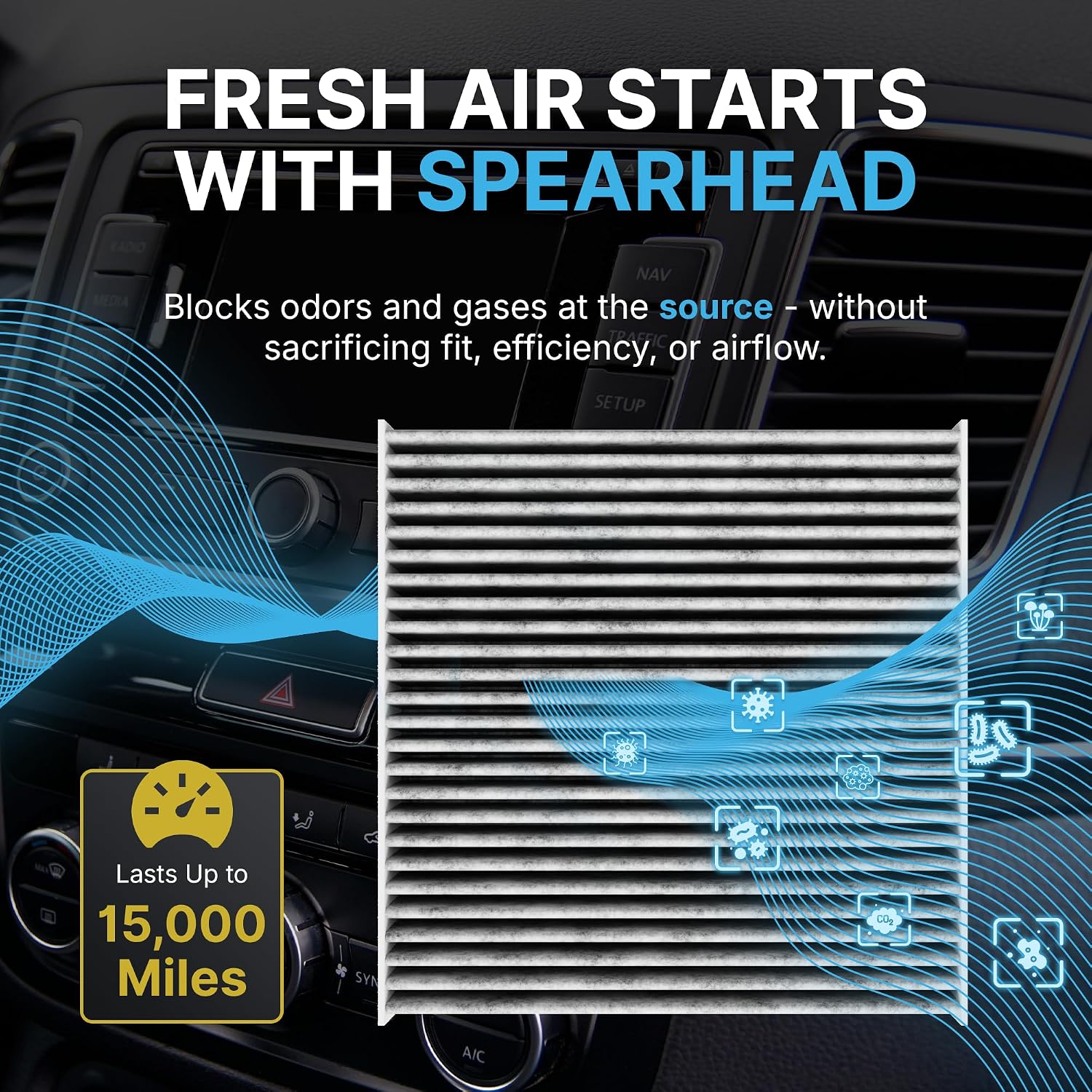
If you’re hunting for the best cabin air filter and you’d rather not pay a shop $90 to swap a $12 part, this guide is for you. I’ve been doing my own maintenance for years, and cabin and engine air filters are the two easiest wins in the whole maintenance schedule — most cars take under five minutes and zero tools. My top pick overall is the Spearhead Premium Breathe Easy BE-285: honeycombed activated carbon, a 15,000-mile interval, and the largest review base in the category at over 65,000 ratings. If you’re on a tight budget, the EPAuto CP285 does 90% of the same job for a few dollars less. Below I’ll cover five cabin filters, two engine filters, what actually matters when choosing, and how to do the swap yourself.
As an Amazon Associate, Top10Great earns from qualifying purchases. This post contains affiliate links, which means we may receive a commission if you buy through our links, at no extra cost to you.
Quick Comparison: Cabin and Engine Air Filters
| Filter | Best For | Key Spec | Price | Link |
|---|---|---|---|---|
| Spearhead Premium Breathe Easy BE-285 | Best Overall | Honeycombed carbon, 15,000-mile interval | $ | Check price |
| EPAuto CP285 Premium Cabin Air Filter | Best Budget | Activated carbon, PM2.5 rated | $ | Check price |
| Bosch 6055C HEPA Cabin Air Filter | Best Premium / allergies | 99.97% at 0.3 microns (ISO 29463-3) | $$ | Check price |
| FRAM CF11182 Fresh Breeze | Best for odors | Carbon + Arm & Hammer baking soda | $$ | Check price |
| K&N VF2000 Washable Cabin Filter | Best reusable cabin filter | Washable, 50,000-mile service life | $$$ | Check price |
| EPAuto GP075 (CA10755) Engine Air Filter | Best engine filter value | Cellulose/synthetic panel, 99% efficiency | $$ | Check price |
| K&N 33-2443 High-Flow Engine Filter | Best lifetime engine filter | 4-layer oiled cotton, clean every 75,000 mi | $$$ | Check price |
Prices checked August 2026 and move around constantly on Amazon — treat the brackets as a guide, not a quote. Every part number below fits a specific family of vehicles. Always cross-reference the number against your exact year, model, and engine before ordering.
1. Spearhead Premium Breathe Easy BE-285 — Best Overall
The BE-285 is a multi-layer charcoal cabin filter: a synthetic outer layer for the big stuff (leaves, pollen, hair), a honeycombed activated carbon layer for gases and odors, and an electrostatic inner layer for fine particles. The honeycomb structure is the part that matters — it exposes more carbon surface area to airflow than a flat carbon sheet, so odor control holds up longer through the filter’s life.
- Rated for 15,000 miles instead of the usual 12,000, which lines up neatly with a synthetic oil change so you can do both in one go.
- Over 65,000 verified Amazon ratings at 4.7 stars — by far the largest real-world dataset of any cabin filter I looked at.
- Handles exhaust and smoke smells noticeably better than a plain particulate filter, which is the single most common reason people replace this part in the first place.
- Sits at the low end of the price range despite the longer interval, so cost per mile is the best on this list.
Honest cons: Reviewers consistently note the filter is thicker and stiffer than the OEM part, which makes it a tighter squeeze through the glove-box opening on some cars — you may need to flex it slightly to get it seated. And the carbon isn’t formulated for heavy diesel exhaust; if you commute behind trucks daily, expect the odor control to fade before the 15,000-mile mark.
Who should buy it: Almost everyone. If your part number cross-references to the BE-285 family, this is the default choice. Check current price on Amazon.
2. EPAuto CP285 — Best Budget
The EPAuto CP285 is the filter I recommend when someone tells me they’ve never changed theirs because it “seemed expensive.” It’s genuine activated carbon media with a PM2.5 rating, backed by more than 44,000 reviews at 4.7 stars.
- PM2.5 rating means it captures particles down to 2.5 microns — the size range that gets past your upper airway and into your lungs. Pollen at 10–50 microns is easy; fine road dust and combustion soot is the harder test.
- Ships with a vehicle-specific installation guide, which genuinely helps the first time you’re figuring out glove-box removal and airflow-arrow orientation.
- Frequently available in 2- and 3-packs, which drops the per-filter cost further if you’re maintaining more than one car.
Honest cons: The carbon saturates toward the end of its 12,000-mile life, so the last couple thousand miles give you noticeably less odor control. And because the media is dark gray, you can’t eyeball how dirty it is — a complaint that shows up repeatedly in reviews. Note also that the bulk of negative reviews on this listing are people who ordered the wrong part number, not people unhappy with the filter.
Who should buy it: Budget-conscious owners who still want carbon odor control. Check current price on Amazon.
3. Bosch 6055C HEPA — Best Premium
This is the only true HEPA option here: 99.97% capture at 0.3 microns per ISO 29463-3, the same standard used in hospital and cleanroom filtration. A typical cabin filter catches roughly 95–98% of particles above 1 micron. The Bosch is working three times smaller and far more thoroughly.
- Triple-layer stack — melt-blown electrostatic media, dense HEPA media, and static cotton — catches particles by three different mechanisms.
- Molded structural ribs stop the dense media from bowing under blower pressure, which is what creates bypass gaps around the edges on cheap filters.
- Meaningful for allergy sufferers, asthma, and anyone driving through wildfire smoke season.
Honest cons: No activated carbon at all, so it does nothing for exhaust smell or musty odors — this is a particle filter, full stop. And the denser media adds airflow restriction; some owners report slightly weaker output on the highest fan speed. If your blower is already tired, that’s worth weighing.
Who should buy it: Allergy and asthma sufferers, and anyone who prioritizes what they’re breathing over what they’re smelling. Check current price on Amazon.
4. FRAM CF11182 Fresh Breeze — Best for Odors
FRAM’s trick is adding Arm & Hammer baking soda on top of the activated carbon. Carbon adsorbs odor molecules physically; baking soda neutralizes acidic odor compounds chemically. Two mechanisms instead of one, and the difference in the first few thousand miles is real — this is the freshest-smelling filter I’ve used.
- Dual odor control (carbon + baking soda) rather than carbon alone.
- FRAM claims capture of roughly 98% of dust, pollen, and airborne allergens without choking airflow.
- Widely stocked, so if you need one today you can usually find it locally as well as online.
Honest cons: It’s one of the pricier standard filters here for a 12,000-mile interval, so cost per mile is worse than the Spearhead. Reviewers also note the baking-soda freshness fades fastest of any feature — the strong “new filter” smell is largely gone after a few months, even though filtration continues fine.
Who should buy it: Anyone fighting a persistent musty or smoky cabin smell. Check current price on Amazon.
5. K&N VF2000 — Best Reusable Cabin Filter
The VF2000 is washable. You pull it, rinse it, let it dry, and put it back — rated for around 50,000 miles of service. Over the life of a car that’s one purchase instead of five or six.
- Electrostatically charged synthetic media grabs dust and releases it when washed.
- Polyurethane frame holds its shape far better than cardboard-framed disposables, which sag over time.
- Pre-treated to resist mold, mildew, and bacteria growth in the housing.
- Cheapest option over 100,000 miles by a wide margin.
Honest cons: The up-front price is roughly four times a good disposable, so it only pays off if you keep the car. And it needs to dry completely before reinstalling — reviewers who rushed this report a damp, musty smell for the first week. Plan the wash for a day you don’t need the car.
Who should buy it: Long-term owners who don’t mind a maintenance ritual. Check current price on Amazon.
Engine Air Filter Replacement: Two Picks Worth Buying
Your cabin filter protects your lungs. Your engine air filter protects your engine — it’s the only thing between the intake tract and every grain of road grit your car drives through. Engine air filter replacement is even easier than the cabin filter on most vehicles: pop the airbox clips, lift out the old panel, drop in the new one.
EPAuto GP075 (CA10755) — Best Engine Filter Value
Cellulose/synthetic blend media rated around 99% efficiency, with drop-in OEM-equivalent fitment and over 6,200 reviews at 4.7 stars. It costs a fraction of the dealer part for the same construction, installs in under two minutes with no tools, and the blended media flows better than the all-cellulose filters at the very bottom of the price range.
Honest cons: Disposable only — over 100,000 miles that’s roughly eight purchases. Some owners also report minor fitment variance between model years on the same platform, so confirm the cross-reference for your exact year and engine before ordering. Check current price on Amazon.
K&N 33-2443 — Best Lifetime Engine Filter
Four-layer oiled cotton gauze, washable, cleaned roughly every 75,000 miles, and backed by K&N’s lifetime limited warranty. It flows better than any disposable panel, which is worth a modest bump in throttle response — expect crisper part-throttle feel rather than horsepower you can feel in your back.
Honest cons: Over-oiling after cleaning is a genuine, well-documented problem — excess oil migrates onto the mass airflow sensor, the engine reads lean airflow, runs rich, and throws a P0101 code. Apply oil sparingly in light passes and let it wick in for 20 minutes. Second con: the up-front price is roughly three times a disposable, so it only makes financial sense past about 36,000 miles of ownership. Check current price on Amazon.
Buying Guide: What Actually Matters
Fitment first, everything else second. A filter that doesn’t seal is worse than a cheap one that does, because unfiltered air simply flows around the edges. Look up your year, model, and engine, get the part number, and only then compare brands. This is the step people skip, and it’s why most one-star reviews on these listings exist.
Particulate vs. charcoal cabin filter. Every cabin filter catches particles. Activated carbon (charcoal) adds chemical adsorption for exhaust fumes, VOCs, and odors. If you drive in traffic, near industry, or through smoke, carbon is worth the extra few dollars. If your only concern is pollen and dust, a good particulate filter is fine.
HEPA vs. carbon is a real trade-off. Right now no single cabin filter gives you both hospital-grade particle capture and strong odor control. Pick based on your problem: breathing issues point to HEPA, smells point to carbon.
Replacement interval and cost per mile. A $9 filter rated for 15,000 miles beats an $18 filter rated for 12,000. Do that math before you’re swayed by a brand name.
Airflow restriction. Denser media filters better but makes your blower motor work harder. That’s an acceptable trade for a HEPA filter, but it’s the reason you shouldn’t leave any filter in past its interval — a clogged one strains the blower and cuts your defroster performance right when you need it.
Reusable only pays off if you keep the car. Washable filters win on long ownership and lose on short. Be honest about which one you are.
Cabin Air Filter Replacement FAQ
How often should I replace my cabin air filter?
Most manufacturers specify every 12,000 to 30,000 miles. Once a year or every 12,000–15,000 miles is the practical rule. Shorten it if you drive in heavy traffic, on dirt roads, or through high-pollen or smoky areas.
What are the symptoms of a bad cabin air filter?
Weak airflow from the vents, a musty or sour smell when the fan comes on, worse allergy symptoms in the car, dust settling fast on interior surfaces, a whistling or rattling noise from the vents, and a defroster that won’t clear the windshield.
Where is the cabin air filter located?
On most vehicles it’s behind or under the glove box. On some it sits under the hood at the base of the windshield in the cowl area. Your owner’s manual will tell you exactly — check it before you start pulling panels.
Can I replace it myself?
Yes, and this is the easiest DIY job on the car. On the typical glove-box design you squeeze the sides of the glove box to let it swing down past its stops, unclip the filter housing cover, slide out the old filter, and slide in the new one with the airflow arrow pointing the same direction the old one did (usually down). Five minutes, no tools. Take a photo of the old filter’s orientation before you pull it if you’re unsure.
What happens if I never change it?
Airflow drops, your HVAC works harder, the cabin develops a persistent musty smell as moisture and bacteria collect in the media, and the defroster gets slow — a real safety issue in bad weather. It also puts avoidable load on the blower motor.
The Verdict
For most people, the Spearhead Premium Breathe Easy BE-285 is the one to buy: best odor control per dollar, a 15,000-mile interval, and a review base nobody else comes close to. If you want to spend less, the EPAuto CP285 is the budget pick and gives up very little. Allergy sufferers should step up to the Bosch 6055C HEPA and accept the loss of odor control. And while you have the tools out — which is to say, no tools at all — do your engine air filter too. The EPAuto GP075 covers it for the price of a couple of coffees.