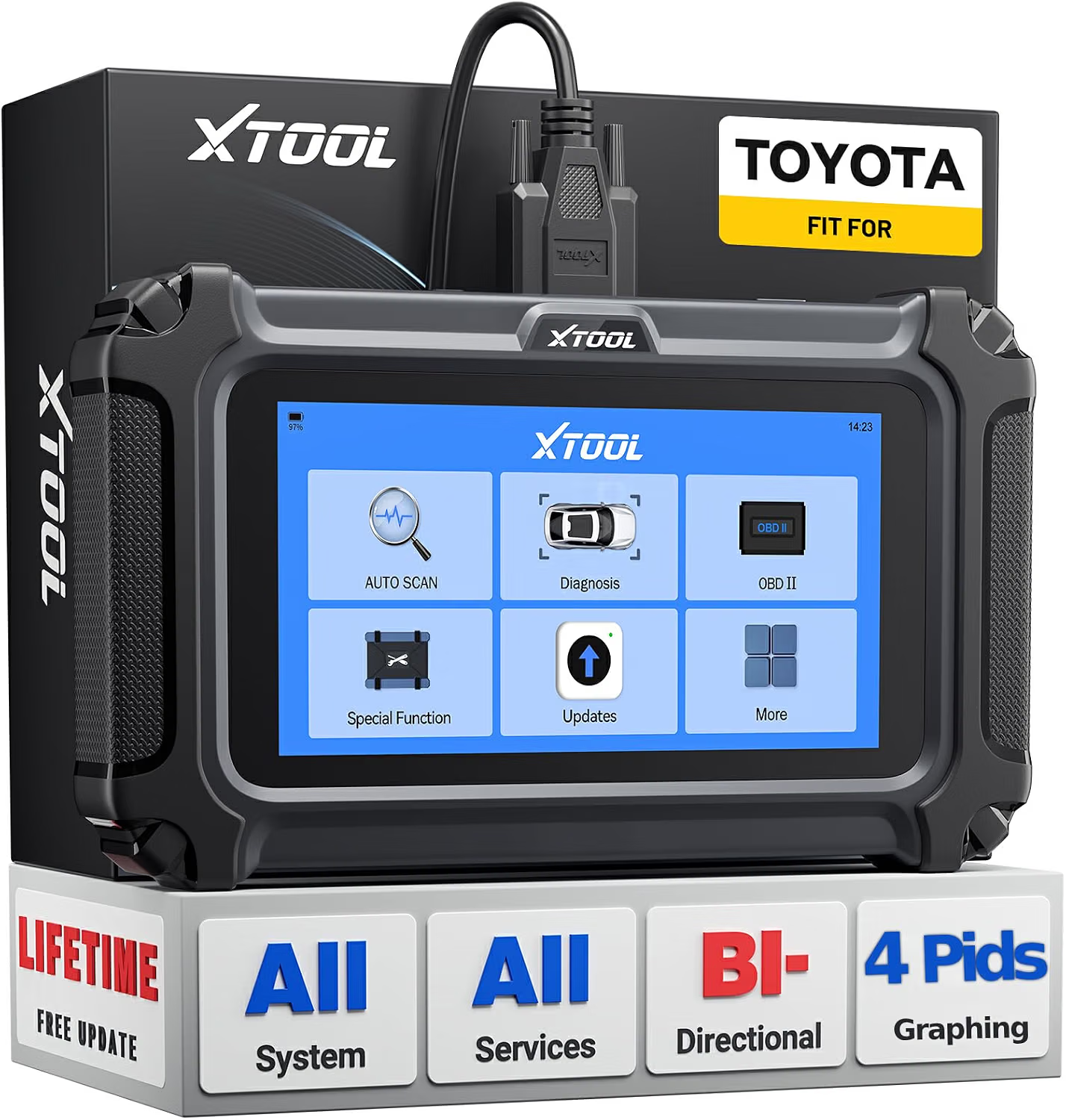
If you own a Tacoma and you’re tired of paying a shop $150 to tell you what a $2 sensor is doing, this guide is for you. I’ve been turning wrenches in my own garage for years, and the single tool that changed how I maintain trucks was a proper scanner. Not a $20 code reader — a scan tool that talks to every module. The best OBD2 scanner for a Toyota Tacoma, for most owners, is the XTOOL IP500: it’s built specifically for the Toyota/Lexus/Scion family, it does bidirectional control, and it costs about a fifth of what a dealer charges for one diagnostic visit. If you just need the check engine light read, skip to the ANCEL AD310 near the bottom and save yourself $160.
As an Amazon Associate, Top10Great earns from qualifying purchases. This post contains affiliate links, which means we may receive a commission if you buy through our links, at no extra cost to you.
Quick Comparison: Best OBD2 Scanner for Toyota Tacoma Picks
| Scanner | Best For | Key Spec | Price | Link |
|---|---|---|---|---|
| XTOOL IP500 | Best Overall | Toyota-dedicated, bidirectional, lifetime updates | $$ | Check price |
| ANCEL AD310 | Best Budget | Engine codes only, no battery needed | $ | Check price |
| Autel MaxiCOM MK808S | Best Premium | 7″ tablet, 3,000+ active tests, 28+ resets | $$$ | Check price |
| ANCEL TD700 | Best Toyota-specific value | Full-system 1996–2021 Toyota, TPMS relearn | $$ | Check price |
| Innova 5610 | Best US-based support | Bidirectional, no subscription, RepairSolutions2 | $$$ | Check price |
| FOXWELL NT604 Elite | Cheapest full-system | Engine, ABS, SRS, transmission | $$ | Check price |
Where the Tacoma’s OBD2 Port Is (And Why It Matters)
Before you buy anything, go find the port. On every Tacoma from 1996 onward it’s the 16-pin trapezoidal connector Toyota calls DLC3: under the driver’s side dash, right of the steering column, roughly above the parking brake pedal, facing down. On second-gen trucks it sits further back under the lower trim than on a Camry, so you’ll be on your back with a flashlight the first time. No tools needed — it’s just recessed. Pre-1996 trucks have the round 22-pin DLC1 under the hood instead, which needs an adapter cable.
The generation split matters for buying, too:
- 1st gen (1995–2004) — 3.4L 5VZ-FE V6 and the 2.4/2.7 fours. Almost any tool reads engine codes; almost nothing reads ABS.
- 2nd gen (2005–2015) — 2.7L 2TR-FE and 4.0L 1GR-FE. The sweet spot for cheap full-system tools: ABS, SRS and transmission are all readable by $100 scanners.
- 3rd gen (2016–2023) — 2.7L 2TR-FE and the 3.5L 2GR-FKS V6. Bidirectional matters here, mostly for ABS bleeding and TPMS relearns.
- 4th gen (2024+) — 2.4L turbo i-FORCE and the i-FORCE MAX hybrid. Newer modules use CAN FD and DoIP, and older budget scanners will often connect and read generic engine codes without enumerating the full module list. Check year coverage before buying, and assume no sub-$150 tool reads the hybrid’s high-voltage battery.
1. XTOOL IP500 — Best Overall
The IP500 is XTOOL’s Toyota/Lexus/Scion-only tool, and that focus is exactly why it’s my pick for a Tacoma. Instead of a thin layer of coverage across 200 brands, you get deep access to the modules Toyota actually put in your truck, at around $189.
- True bidirectional control — you can command the fuel pump, cooling fans, and A/C clutch from the screen instead of jumping relays in the engine bay.
- Full-system scan across engine, transmission, ABS, SRS, TPMS and body modules, not just powertrain.
- Lifetime free updates with no subscription, which is unusual at this price and matters if you’re going to own the truck for another decade.
- All the reset services you actually use on a Tacoma: oil light, throttle body relearn, brake pad reset, steering angle.
Honest cons: reviewers consistently say the menu structure is confusing for a first-time scan tool owner — you will spend an evening learning it. And the “1996–2024” coverage claim is optimistic at both ends; several owners report reduced module access on very early trucks and on the newest 4th-gen models.
Who should buy it: the Tacoma owner who does their own brakes, sensors and fluid services and wants dealer-adjacent capability without a dealer-adjacent price.
Check the current price on Amazon
2. ANCEL AD310 — Best Budget
Around $25–30, and it has outsold nearly everything else in this category for a decade for one reason: it does one job flawlessly. Plug it into the DLC3, and it pulls and clears engine codes in under ten seconds. No app, no pairing, no charging — it draws power from the truck.
- Reads and clears codes, shows freeze frame data and I/M readiness — everything you need to pass a smog check.
- Supports every protocol a Tacoma has ever used, including the older J1850 and KWP2000 on first-gen trucks.
- 2.5-foot cable and a rugged housing that survives being thrown in a toolbox for years.
- No batteries, no updates, nothing to go stale.
Honest cons: it reads engine codes only — no ABS, no SRS, no transmission. And the screen is not backlit, which is a genuine annoyance when you’re under the dash at night, a complaint that shows up repeatedly in reviews.
Who should buy it: anyone who wants to know what the check engine light means before calling a shop. Keep it in the glovebox.
Check the current price on Amazon
3. Autel MaxiCOM MK808S — Best Premium
If you work on more than just the Tacoma, this is the tool. It’s a 7-inch Android tablet running Autel’s diagnostics, typically $350–450, with 3,000+ active tests and 28+ service functions across 200+ brands.
- The big screen makes live data graphing genuinely usable — you can watch fuel trims and O2 sensor switching while the truck idles instead of squinting at a 2.8-inch display.
- Auto VIN identification means it pulls your Tacoma’s exact configuration instead of making you scroll through year/model menus.
- Service functions cover the jobs Tacoma owners actually pay dealers for: ABS bleed, steering angle calibration, battery registration, injector coding.
- Broad brand coverage, so it also handles your spouse’s Honda and your neighbour’s F-150.
Honest cons: owners regularly report Wi-Fi dropping during firmware updates, which is fixable by moving closer to the router but is a bad first impression on a $400 tool. It also can’t do ECU coding — if you ever want to program a replacement module, this isn’t the tool.
Who should buy it: the serious home mechanic or side-hustle tech with a multi-vehicle driveway.
Check the current price on Amazon
4. ANCEL TD700 — Best Toyota-Specific Value
At around $120, the TD700 is the cheapest way to get real full-system Toyota coverage. It’s built for Toyota, Lexus and Scion from 1996 to 2021, which covers first through third-gen Tacomas completely.
- Reads and clears codes across ABS, SRS, transmission and engine — with TCM data, which is genuinely useful if you’re chasing a rough shift on a 2nd-gen automatic.
- TPMS relearn, which saves a trip to the tire shop every time you rotate on a 3rd-gen truck.
- Oil reset takes about twenty seconds; brake pad and EPB service functions included.
- Boots and connects in roughly 15 seconds, noticeably quicker than older ANCEL units.
Honest cons: no bidirectional control — you can read and reset, but you can’t command a component to actuate, which rules out bleeding the ABS by yourself. Owners also note it won’t display transmission fluid temperature, the one live value you most want during a drain-and-fill on a Tacoma automatic.
Who should buy it: owners of 1996–2021 Tacomas who want ABS and airbag codes without spending $200+.
Check the current price on Amazon
5. Innova 5610 — Best US-Based Support
The 5610 is the American option, running $300–350, and it’s the one I’d recommend to someone who wants a phone number to call when something doesn’t work. It holds roughly 4.5 stars and pairs with Innova’s RepairSolutions2 app for verified fixes.
- Bidirectional control for active tests — fuel pump commands, electronic parking brake retraction for rear brake service.
- Engine, transmission, ABS and SRS diagnostics with detailed live data.
- Free updates with no subscription, ever. This is Innova’s whole pitch and they’ve stuck to it.
- US-based technical support, which is the real differentiator against the import brands.
Honest cons: the handheld form factor feels dated next to tablet-style tools at similar money, and the small screen makes scrolling long live-data lists tedious. Reviewers also note the best repair guidance sits in the companion app rather than on the tool itself, which slows you down when you’re under the hood without your phone.
Who should buy it: owners who want bidirectional capability and support in their own time zone.
Check the current price on Amazon
6. FOXWELL NT604 Elite — Cheapest Full-System Scanner
Roughly $90–110, and it hits the four systems most Tacoma owners care about: engine, ABS, SRS and transmission. It works out of the box with no software downloads.
- Four-system coverage at a price where most tools only do engine.
- AUTOVIN identifies the truck automatically instead of making you dig through menus.
- Ships with a hard protective case, which sounds trivial until you’ve cracked a screen in a toolbox.
- Live data with graphing on a 4.3-inch colour screen.
Honest cons: no service functions — no oil reset, no TPMS relearn, no ABS bleed. It reads and clears, and that’s the extent of it. Reviewers also mention scan speed varies noticeably between modules.
Who should buy it: the owner who wants ABS and airbag codes on a 2nd or 3rd-gen truck for around a hundred dollars.
Check the current price on Amazon
What About a Bluetooth Dongle?
If you’d rather use your phone than carry a handheld, the OBDLink MX+ (around $140) lives in the DLC3 permanently and streams to the OBDLink app, with enhanced Toyota access that generic $15 ELM327 clones can’t reach. The catch is that some of those enhanced functions are paid add-ons inside the app, and juggling a phone with greasy hands is fiddlier than it sounds. We covered it in more depth in our guide to Techstream-compatible Lexus and Toyota scanners.
Buying Guide: What Actually Matters for a Tacoma
Match the tool to your generation. This is the mistake I see most often. A 2010 Tacoma is easy — almost every full-system tool has complete coverage. A 2024 with the turbo four or the i-FORCE MAX hybrid is not: newer modules use CAN FD and DoIP, and plenty of tools that advertise “1996–2026” only mean generic engine codes on the newest trucks. Look for explicit CAN FD support, and for the hybrid, explicit hybrid battery coverage.
Decide whether you need bidirectional. Bidirectional means the tool sends commands, not just receives them. On a Tacoma the two jobs that actually require it are ABS bleeding after you’ve opened the brake system, and cycling components you’d otherwise have to jump manually. If you only ever read and clear codes, you’re paying for nothing.
Full-system beats generic every time. A generic OBD2 reader legally only has to access emissions-related powertrain codes. Your ABS light, airbag light and transmission faults live in modules it can’t see. If your budget allows anything above $80, get full-system.
Check the update policy before you buy. Some brands include lifetime updates; others give you a year and then want $100+ annually. On a truck you plan to keep, that difference outweighs the purchase price within three years.
Don’t confuse these with Techstream. Toyota Techstream is dealer software that runs on a Windows laptop through a Mini-VCI or Mongoose cable, and it does things no consumer handheld does. None of the scanners here are Techstream, and any listing claiming otherwise is being loose with the truth.
FAQ
Will any OBD2 scanner work on a Toyota Tacoma?
Any OBD2 scanner will read engine codes on a 1996-or-newer Tacoma — that’s federally mandated. But “work” and “work well” differ. Basic readers can’t touch ABS, SRS or transmission modules, and on 4th-gen trucks (2024+) older scanners may connect but only see generic powertrain data.
Where is the OBD2 port on a Toyota Tacoma?
Under the driver’s side dash, right of the steering column, roughly above the parking brake pedal, facing downward. It’s a black 16-pin trapezoidal connector. On 2nd-gen trucks it’s recessed further under the lower trim than on most Toyotas — you may need to get your head down near the floor to see it.
Do I need a bidirectional scanner for my Tacoma?
Only for active testing. Bleeding the ABS module after a brake job, commanding the fuel pump, retracting an electronic parking brake — those need bidirectional. Reading and clearing codes, checking live data and resetting the oil light do not. Most owners are fine without it; owners who do their own brake work aren’t.
Can these scanners clear the check engine light on a Tacoma?
Yes, every tool here clears codes and turns the light off. Fix the underlying fault first, though — clearing a P0420 without addressing the converter or an upstream lean condition just means the light returns in a few drive cycles, and it wipes your readiness monitors, which will fail you at a smog station.
Is Toyota Techstream free, and do I need it?
Techstream is licensed dealer software, not free, and it needs a Mini-VCI or Mongoose cable plus a Windows laptop. For most owners it’s overkill — a bidirectional handheld covers the great majority of what a Tacoma owner would use it for, without the laptop.
Verdict
For most Tacoma owners, the XTOOL IP500 is the right tool at the right price — Toyota-focused, bidirectional, lifetime updates, around $189. If you only need the check engine light decoded, the ANCEL AD310 does it for under $30 and will outlive the truck. And if you’re working on a driveway full of vehicles, the Autel MaxiCOM MK808S justifies the jump to $400.