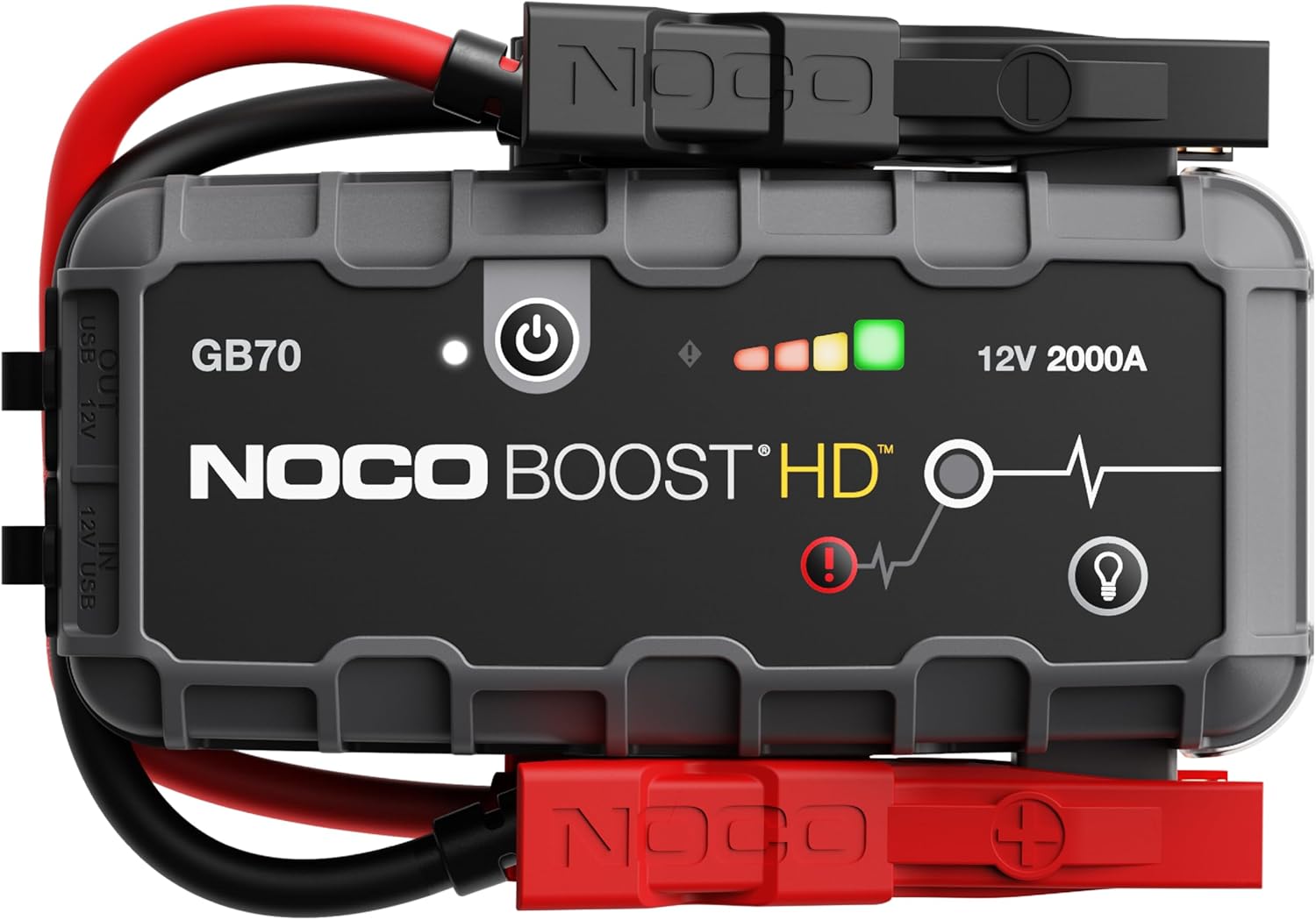
If you drive a Toyota Tundra and you have ever turned the key to a single click, you already know why I am writing this. The best jump starter for a Toyota Tundra in 2026 is the NOCO Boost HD GB70 — 2,000 amps, rated to 8.0L gas, and the unit Tundra owners recommend to each other more than any other. I have spent years working on trucks in my own driveway, and this guide is for Tundra owners specifically: the 4.6L and 5.7L V8s of the 2007–2021 trucks, the 3.4L twin-turbo i-FORCE V6 in the 2022+ generation, and the i-FORCE MAX hybrid, which has a jump-start procedure most guides ignore entirely. Below are six units I would actually keep in a Tundra, plus the fitment details — battery location, cable length, cold-weather headroom — that decide whether a pack works on your truck or just sits in the bed box.
As an Amazon Associate, Top10Great earns from qualifying purchases. This post contains affiliate links, which means we may receive a commission if you buy through our links, at no extra cost to you.
Quick Comparison: Jump Starters for the Toyota Tundra
| Product | Best For | Key Spec | Price | Link |
|---|---|---|---|---|
| NOCO Boost HD GB70 | Best Overall | 2,000A · up to 8.0L gas | $$ | Check price |
| GOOLOO GP4000 | Best Budget | 4,000A peak · 24,000mAh | $ | Check price |
| WOLFBOX MegaVolt24 (MV24) | Best Premium | 4,000A · 88.8Wh · 65W recharge | $$$ | Check price |
| HULKMAN Alpha85 | Best for Cold Climates | 2,000A · up to 8.5L gas · IP65 | $$ | Check price |
| NOCO Boost X GBX55 | Fastest Recharge | 1,750A · 60W USB-C PD | $$ | Check price |
| NOCO Boost Plus GB40 | Best Compact Backup | 1,000A · up to 6.0L gas | $ | Check price |
1. NOCO Boost HD GB70 — Best Overall for the 5.7L V8
The GB70 is a 2,000-amp lithium pack rated for gasoline engines up to 8.0 litres. That matters on a Tundra: the 5.7L i-FORCE V8 is the largest engine Toyota put in this truck, and the GB70 clears it with real headroom rather than scraping the limit. Search any Tundra forum for jump starter threads and the same three letters come back — GB70 owners in Oregon, New York and Arizona all report it still holding charge after jumping other people’s trucks.
Pros
- 2,000A covers the 5.7L V8, the 4.6L V8 and both 3.4L i-FORCE variants with margin left over.
- Roughly 24-inch cables — long enough to reach the under-hood battery on a 2007–2021 Tundra without balancing the pack on the fender.
- Rated for up to 40 jump starts per charge, and owners routinely report a year of shelf time with charge remaining.
- Spark-proof, reverse-polarity-protected clamps, which is the whole reason to stop using conventional cables between two vehicles.
Cons
- It is roughly $200, and there is a vocal group of owners who think NOCO charges a brand premium — cheaper 2,000A packs do post similar bench numbers in independent testing.
- At about 2.4 lb with the case, it is too bulky for a glove box. It lives in the back seat or a bed box.
Who should buy it: any Tundra owner who wants one pack, wants it to work in ten years, and does not want to think about it again. Check current price on Amazon
2. GOOLOO GP4000 — Best Budget Jump Starter for a Tundra
The GP4000 is the value pick that keeps showing up in Tundra threads, usually from someone who watched a bench-test video and bought it instead of the NOCO. It advertises 4,000 peak amps and a 24,000mAh cell rated for gas engines up to 10L, and it typically sells for a third to half of what the GB70 costs.
Pros
- Enormous capacity headroom for a 5.7L V8 — it is specced for engines far larger than anything Toyota fits to a Tundra.
- The 24,000mAh pack doubles as a genuinely useful power bank for a weekend of camping.
- Roughly 4.6 stars across more than 8,500 Amazon ratings, so the sample size is real.
- Frequently discounted well below $90, which makes a second unit for a spouse’s car easy to justify.
Cons
- Build quality is a step below NOCO — the clamps and cable jacket feel lighter, and reviewers who compare them side by side notice it immediately.
- Warranty and support are less consistent than the established brands; if a unit fails at month 14, expect more back-and-forth.
Who should buy it: owners who want maximum cranking capacity per dollar and are not precious about finish. Check current price on Amazon
3. WOLFBOX MegaVolt24 — Best Premium Pick
The MegaVolt24 (sold as MV24) is the do-everything option: 4,000 amps, an 88.8Wh cell, a 65W quick charger that refills it in around 1.3 hours, and an LED display that tells you the state of the pack and the battery you are connected to. Independent tool-testing outlets have ranked it at or near the top of the category, which is unusual for a newer brand.
Pros
- Rated to 10L gas — total overkill for a Tundra, which is exactly what you want at −20°F.
- 65W two-way charging means you are not waiting overnight to get it usable again after a jump.
- The display removes the guesswork about whether the pack has enough charge left to try again.
- Comes in a hard storage case rather than a cloth bag.
Cons
- It is physically large. In a Tundra that is fine; in a sedan it eats real trunk space.
- WOLFBOX is a newer name in this category, so long-term reliability data is thinner than NOCO’s decade of field use.
Who should buy it: owners who tow, overland, or want one pack that also runs a tire inflator and a fridge. Check current price on Amazon
4. HULKMAN Alpha85 — Best for Cold-Climate Tundras
If your Tundra lives somewhere that hits −30, the Alpha85 deserves a hard look. It is a 2,000A pack rated to 8.5L gas with a 3.3-inch display, IP65 dust and water resistance, and 65W charging that takes it to full in about 90 minutes. It also holds charge remarkably well — owners report leaving it in a truck for six to eight months and finding it still near 95 percent.
Pros
- 8.5L gas rating gives the 5.7L V8 more margin than most 2,000A packs.
- The big display shows exact charge percentage and error codes, so a failed attempt tells you why.
- IP65 sealing with port flaps — it survives being handled with wet gloves in a snowstorm.
- Very low parasitic drain, which is the specification that actually matters for a pack that sits unused for a year.
Cons
- The included drawstring cloth bag offers no impact protection for that large glass screen. It is the single most common complaint, and it is fair — budget for the EVA case.
- A minority of reviewers report it refusing to engage on a completely flat battery without using the manual boost override.
Who should buy it: northern-climate owners and anyone who wants to see what the pack is doing. Check current price on Amazon
5. NOCO Boost X GBX55 — Fastest Recharge
The GBX55 is NOCO’s 1,750-amp unit rated for 7.5L gas engines, so it covers every Tundra engine ever built. Its headline feature is 60W USB-C Power Delivery: five minutes on a decent charger gets it to a usable jump. It shows up regularly in 2022+ Tundra threads at around $175.
Pros
- USB-C in and out — one cable charges the pack, your phone, and a laptop.
- UltraSafe 2.0 clamps with spark-proof and reverse-polarity protection.
- Noticeably lighter and more packable than the GB70 while still clearing the 5.7L V8.
- Five-minute emergency top-up is a genuinely different capability, not a marketing line.
Cons
- At roughly $175 it costs nearly as much as the more powerful GB70, which makes it hard to justify on amps alone.
- You need a real 60W PD charger to get the fast recharge; a 5W phone brick makes the feature disappear.
Who should buy it: owners who travel and want the pack usable again quickly. Check current price on Amazon
6. NOCO Boost Plus GB40 — Best Compact Backup
The GB40 is the 1,000-amp entry point, rated for gas engines up to 6.0L. On paper the 5.7L V8 fits. In practice you are using nearly all of the pack’s rating, and that is a different proposition in January than in July. With over 115,000 Amazon ratings at roughly 4.6 stars, it is the most-reviewed jump starter in the category for good reason — it is small, cheap and it works.
Pros
- Genuinely compact — it fits in a centre console or under a seat.
- Around $100, and regularly discounted below $85.
- Same spark-proof NOCO clamp design as the GB70.
- Enormous review base, so the failure modes are well documented.
Cons
- Short cables — this is the exact complaint raised in Tundra forum threads, where owners specifically ask for leads longer than 12 inches. On a truck with a high engine bay, it is a real limitation.
- 1,000A leaves little headroom on a cold 5.7L V8. Owners of NOCO’s mid-size packs report failed attempts that traced back to a unit that was not fully charged — on a V8, a partial charge is the difference between starting and not.
Who should buy it: owners of the 3.4L V6 trucks, or anyone wanting a compact second pack. Check current price on Amazon
How to Choose a Tundra Portable Jump Pack
Amp rating and engine size. Match the pack to the largest engine you might need to start, not the smallest. For a 5.7L V8, buy something rated to at least 7.0L gas. A 6.0L-rated pack technically covers it, but cold oil and a tired battery eat that margin fast. The 3.4L twin-turbo i-FORCE is easier to crank, and a 1,000A pack is adequate for it.
Cable length. This is the specification nobody lists and Tundra owners keep asking about. A Tundra’s battery sits high and toward the front of a deep engine bay. Twelve-inch leads mean the pack dangles or rests on the intake; 24-inch leads let it sit on the fender or the ground. Longer is better on a full-size truck.
Battery location — and it changes by generation. On 2007–2021 trucks the 12V battery is under the hood. On the 2022+ i-FORCE MAX hybrid it lives under the rear seat, with a designated jump-start terminal in the engine-bay fuse box — you connect to that terminal, not directly to the hybrid system. Owners genuinely get caught out by this; check the jump-starting section of your owner’s manual before you need it, not after.
Self-discharge and charge discipline. The most common real-world failure is not an underpowered pack, it is a pack that was at 40 percent. Look for low parasitic drain, then set a calendar reminder to top it up twice a year.
Safety features. Spark-proof connection and reverse-polarity protection should be non-negotiable. Anyone who has watched cables glow red during a conventional vehicle-to-vehicle jump understands why.
Toyota Tundra Jump Starter FAQ
Which brand jump starter is best?
NOCO has the longest field record and the most consistent quality control, which is why it dominates owner recommendations. HULKMAN and WOLFBOX now match or beat it on features and recharge speed, and GOOLOO wins on price per amp. For a Tundra specifically, any of them works if the gas-engine rating clears your motor with margin.
How do you jump start a Toyota Tundra?
Turn everything off, connect the red clamp to the positive terminal and the black clamp to a clean unpainted chassis ground, then power on the pack and crank. On the i-FORCE MAX hybrid, use the jump-start terminal in the engine-bay fuse box rather than reaching under the rear seat. Consult the jump-starting section of your owner’s manual for your model year — the procedure differs between the V8 and hybrid trucks.
How many amps do I need to jump start a 5.7L V8?
Look for at least 1,500–2,000 amps, or a pack rated to 7.0L gas or higher. The 5.7L is a large-displacement V8 and cold cranking demands more than the sticker rating suggests.
What is the best jump starter for a 4×4 or off-road truck?
Prioritise sealing, cable length and a display. The HULKMAN Alpha85’s IP65 rating and the WOLFBOX MegaVolt24’s hard case both suit trucks that see mud and dust. If you are far from help, buy more amps than you need.
Do jump starters work in cold weather?
Lithium packs lose capacity in deep cold. That is the argument for buying more amps than your engine strictly requires and for keeping the pack inside the cab rather than in an unheated bed box overnight.
Verdict
For most Tundra owners, the NOCO Boost HD GB70 is the right buy: enough amps for the 5.7L V8, long enough cables for a truck engine bay, and a track record that Tundra owners themselves keep pointing to. If the price is more than you want to spend, the GOOLOO GP4000 delivers more raw cranking capacity for well under half the money, with a build quality you will notice but probably not mind. Whichever you choose, charge it before you need it.