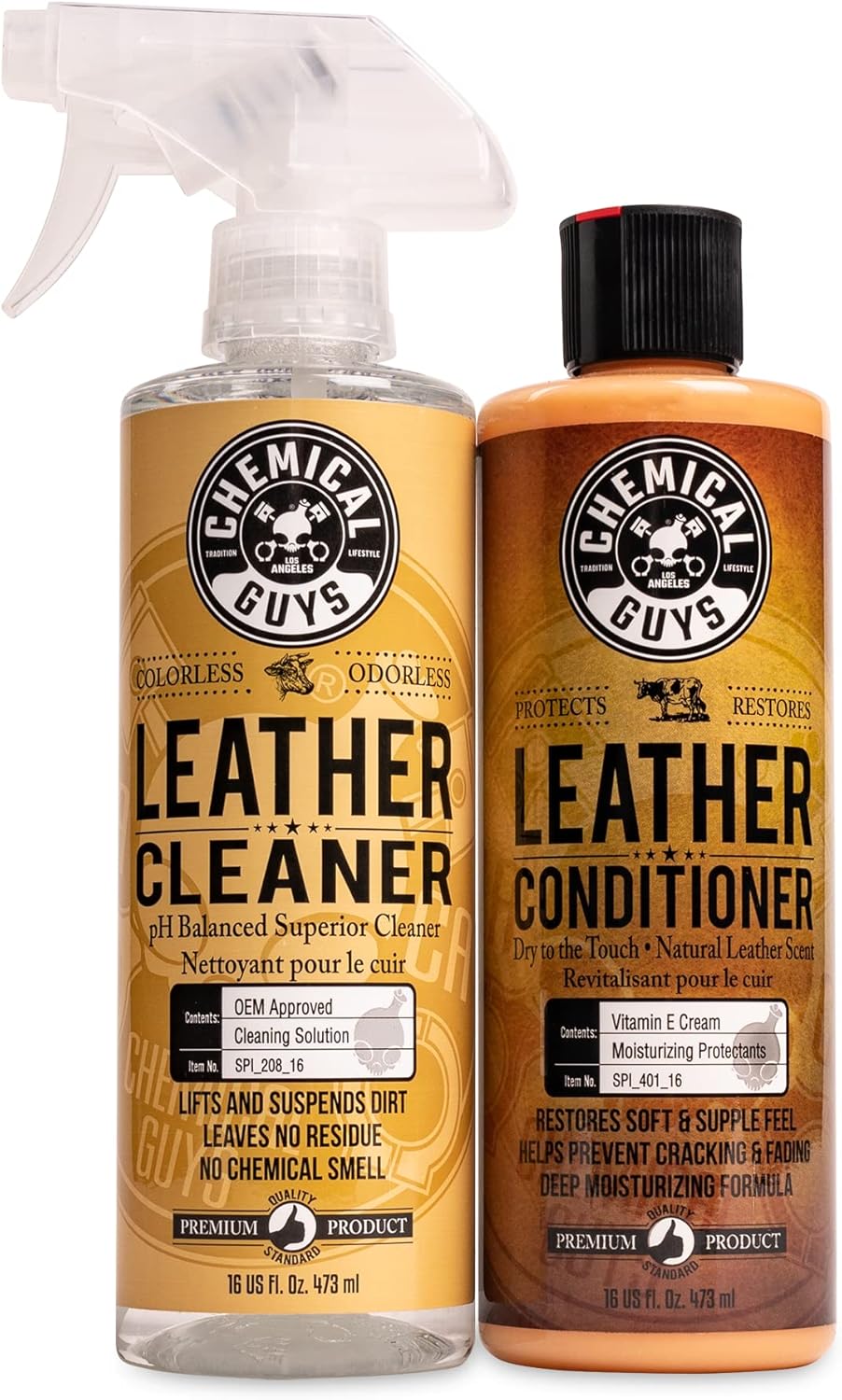
If your driver’s seat bolster has gone shiny and grey, or your light-colored seats are picking up blue jean dye, you need a real leather product — not an all-purpose spray. The best leather cleaner for car seats for most people is the Chemical Guys Leather Cleaner and Conditioner Kit, because it gives you two properly separated 16 oz steps for around the price of one premium bottle. I’ve been doing my own interior work for years, on everything from a beige-interior sedan to a black-leather truck that hauls dogs, and the lesson is always the same: cleaning is what actually makes leather look new, and conditioning is what stops it cracking two summers from now. Below are seven products I’d actually put in a garage cabinet, sorted by leather type, budget, and how bad your seats currently are.
As an Amazon Associate, Top10Great earns from qualifying purchases. This post contains affiliate links, which means we may receive a commission if you buy through our links, at no extra cost to you.
Best leather cleaner for car seats: comparison at a glance
| Product | Best for | Key spec | Price | Link |
|---|---|---|---|---|
| Chemical Guys Leather Cleaner & Conditioner Kit (SPI_109_16) | Best Overall | 2 × 16 oz, pH-balanced cleaner + Vitamin E conditioner | $$ | Check price |
| Meguiar’s Gold Class Rich Leather 3-in-1 Spray (G10916) | Best Budget | 15.2 oz one-step spray, clean + condition + UV block | $ | Check price |
| Koch-Chemie Leather Star | Best Premium | German one-step treatment, matte-satin finish, UV protection | $$$ | Check price |
| Leather Honey Complete Leather Care Kit | Light or delicate leather | Cleaner + concentrated conditioner + 2 lint-free cloths | $$ | Check price |
| Lexol Leather Cleaner & Conditioner Kit | Older, dried-out leather | 8 oz + 8 oz pH-balanced two-step, 2 applicator sponges | $$ | Check price |
| Adam’s Leather & Interior Cleaner | Heavy grime and dye transfer | 16 oz ready-to-use, leather + vinyl + plastic | $$ | Check price |
| Sonax Premium Leather Cleaner (foam) | Perforated & ventilated seats | Foaming applicator, low-moisture, won’t flood perforations | $$ | Check price |
Price brackets are a guide only: $ is under $15, $$ is $15–$35, $$$ is $35 and up. Amazon pricing moves constantly, so check the live listing.
1. Chemical Guys Leather Cleaner and Conditioner Kit — Best Overall
The two-bottle kit most detailers cut their teeth on: a colorless, odorless, pH-balanced cleaner plus a separate Vitamin E conditioner, both 16 oz. That’s two to three complete interiors per bottle if you’re wiping with a microfiber rather than dumping product on the seat. It was listing around $29.99 in mid-2026 — roughly what one bottle of boutique leather treatment costs.
- Two genuinely separate steps, so you clean without adding oils and condition without re-wetting dirt.
- The cleaner works undiluted on coated leather without stripping the topcoat, and plays well with a horsehair brush in seams and perforations.
- pH-balanced and rated safe for natural, synthetic and sealed leather — same bottle does the steering wheel, door cards and shift boot.
- Enough volume to cover a leather sofa or boots too.
Honest cons: the conditioner leaves more shine than a purist wants, and reviewers who apply it heavily report a slick, almost slippery seat for a day or two — wipe it down after 10 minutes rather than letting it sit. The other recurring complaint is the sprayer heads clogging or losing suction within a few months.
Who should buy it: anyone who wants one purchase to cover both steps properly and doesn’t mind a bit of sheen. Check the current price.
2. Meguiar’s Gold Class Rich Leather 3-in-1 Spray — Best Budget
A 15.2 oz spray that cleans, conditions and adds UV protection in one pass. This is the bottle for people who’ll never spend an afternoon detailing but will happily wipe the seats down at the fuel stop.
- Around $10 — the cheapest way to get a real automotive leather formula rather than a household cleaner.
- Aloe and UV inhibitors, which matters if the car sits outside and the seat tops cook every afternoon.
- Dries to a low satin instead of the wet gloss cheap dressings leave.
- Light enough not to clog perforated seats when sprayed onto a towel first.
Honest cons: three-in-one means mediocre at all three — on genuinely dirty seats it smears grime around instead of lifting it, and owners of neglected interiors consistently report going back with a dedicated cleaner. Buyers also complain about the trigger misting unevenly or leaking around the collar.
Who should buy it: owners of a well-kept interior who want quick monthly upkeep, or anyone testing the waters before spending more. Check the current price.
3. Koch-Chemie Leather Star — Best Premium
German-made, for people who care how their leather ages rather than how it looks on Sunday. It cleans and cares in one bottle, but unlike a cheap 3-in-1 it actually restores suppleness and leaves a matte-satin finish rather than a plastic sheen.
- Restores softness on leather that’s gone dry and papery, without darkening the color.
- Genuine factory-matte finish — no gloss, no slick steering wheel.
- Contains UV protection, so it’s preventive rather than purely cosmetic.
- No dilution, no two-step routine: wipe on, wipe off.
Honest cons: the price — typically two to three times the Chemical Guys kit for less product, and often sold through third-party sellers with inconsistent shipping. The scent is also strong on application; reviewers describe a perfumed, cosmetic smell that lingers in a closed car for a day.
Who should buy it: owners of a car whose interior they intend to keep for a decade, and anyone with light grey or cream leather where finish matters more than cost. Check the current price.
Leather conditioner for cars: the gentle and the heavy-duty picks
4. Leather Honey Complete Leather Care Kit — best for light or delicate leather
Made in the USA since 1968, this kit pairs the water-based cleaner with the concentrated conditioner and two lint-free cloths. The conditioner is genuinely concentrated — a little goes further than you expect.
- Odorless, dye-free and non-toxic — the safest bet on beige, cream and off-white seats that harsher cleaners blotch.
- No silicones or solvents, so it won’t build a tacky film over repeated applications.
- The conditioner soaks in rather than sitting on top, and is rated safe on all colors including white.
- Cloths included; nothing else to buy.
Honest cons: too gentle for badly neglected seats — the most common review theme is that heavy grime needs two or three passes, or a stronger cleaner first. The conditioner also wants a long dwell plus a proper buff, and reviewers who skip that report a tacky feel on hot days.
Who should buy it: anyone with light-colored or older, uncoated leather, or anyone who wants a fragrance-free option for allergy reasons. Check the current price.
5. Lexol Leather Cleaner & Conditioner Kit — best for older, dried-out leather
The old-school pro standard: a pH-balanced cleaner and a deep conditioner in 8 oz bottles, plus two applicator sponges. Lexol predates most detailing brands and still gets recommended for saddlery, which tells you how gentle it is.
- pH-balanced and scent-free — won’t bleach, darken or discolor vintage or delicate hides.
- The deep conditioner penetrates rather than coating, which is what dried leather actually needs.
- Ideal prep before a coating or protectant: no film left to block absorption.
- Included sponges spread product evenly instead of in patches.
Honest cons: 8 oz goes fast on a full interior and buyers regularly wish they’d bought the 16 oz version. There are also recurring complaints about bottles arriving leaked or with loose caps, and about the cleaner being underpowered on modern coated leather with real grime on it.
Who should buy it: owners of older vehicles, or anyone conditioning leather that’s already showing fine surface cracking. Check the current price.
6. Adam’s Leather & Interior Cleaner — best for heavy grime and dye transfer
When the seats are past “dusty” and into “the bolster is visibly grey,” this is the 16 oz bottle to reach for. Ready to use, lightly foaming, and it pulls body oils, sunscreen and light denim dye transfer without oils or shine tricks.
- Genuinely strong on buildup while staying safe on coated leather — a rare combination.
- Dries clean and matte with no haze, so you can follow straight on with a conditioner.
- Works on vinyl, plastic and door cards, so one bottle covers the whole interior.
- Foams enough to show where you’ve been, so you don’t double-hit one panel.
Honest cons: a distinct almond scent that plenty of reviewers find too strong in a closed car. It also punishes bad technique — oversaturate the seat instead of spraying onto a brush or towel and you drive moisture into the foam and stitching, which buyers report as a lingering damp smell.
Who should buy it: anyone reviving a neglected interior, or owners hauling kids, dogs and work gear who need a real cleaner rather than a wipe-down spray. Check the current price.
7. Sonax Premium Leather Cleaner — best for perforated and ventilated seats
Perforated seats are where most cleaners cause damage, because liquid runs straight through the holes into the foam and the seat heater below. Sonax’s foaming applicator solves that: the foam clings long enough to lift dirt without flooding the perforations.
- Low-moisture foam is the safest format for perforated, ventilated and heated seats.
- Very effective on blue jean dye transfer — the number one complaint on light-colored seats.
- Wipes clean with no shine, no stickiness and no color change.
- Excellent prep before conditioning; leaves nothing behind to block absorption.
Honest cons: the bottle is awkward to grip with wet hands, and reviewers note the foam pump sputters or dispenses unevenly as it empties. It’s cleaner-only, so you still need a conditioner — the real cost is higher than the sticker.
Who should buy it: anyone with perforated or ventilated seats, and anyone fighting denim dye on pale leather. Check the current price.
Leather care kit buying guide: what actually matters
Know what leather you have. Almost every car built in the last twenty years uses coated (pigmented) leather — a polyurethane topcoat over the hide. That coating is what you’re cleaning and protecting, not the leather itself, so products promising to “feed” the hide are mostly marketing on coated seats. Uncoated aniline leather turns up on some older and high-end interiors, and it needs the gentlest products here.
Buy a cleaner and a conditioner, not a 3-in-1. To clean, a product needs surfactants that lift oil; to condition, it needs to leave oils behind. Doing both in one wipe means doing neither well. A 3-in-1 is fine for maintaining an already-clean interior, but it won’t rescue a dirty one.
Check the ingredients. Water-based and pH-balanced is what you want. Avoid alcohol, ammonia, bleach and heavy solvents — they strip the topcoat and dry the hide, causing exactly the cracking you were trying to prevent. Dish soap is a false economy for the same reason.
Don’t shop by shine. A glossy seat usually means residue sitting on the surface, and residue attracts dirt and makes seats slippery. Properly cleaned leather looks matte and feels dry.
Match the format to your seats, and test first. Foam for perforated and ventilated seats; spray-onto-towel for everything else — never spray directly onto the seat. A few-dollar horsehair brush does more for your results than upgrading the chemical. And test on a hidden bolster every time, even with a product that claims it’s safe for everything.
Leather cleaner and conditioner FAQ
How often should you condition leather car seats?
Every three to six months for conditioning, depending on climate and sun exposure. Cleaning is more frequent — monthly for a daily driver, or whenever the seats look dull. A car parked outside in a hot, dry climate needs conditioning at the shorter end of that range; a garage-kept car can stretch it.
Can you use household cleaners on leather car seats?
Not the strong ones. Bleach, ammonia, all-purpose degreasers and undiluted dish soap strip the protective topcoat and dry the leather out, which leads to cracking. A very dilute mild soap (roughly one part to five parts water) won’t destroy anything, but it won’t condition either — and a purpose-made cleaner is far cheaper than a re-dye job.
What is the difference between a leather cleaner and a leather conditioner?
A cleaner lifts dirt, body oils and dye transfer off the surface and leaves nothing behind. A conditioner replaces the flexibility the surface loses to heat and UV. Cleaning without conditioning leaves leather dry; conditioning without cleaning seals dirt in.
Will leather conditioner make my seats slippery?
It can, if you apply too much or skip the buff. Use a thin coat, let it absorb five to ten minutes, then wipe with a clean dry microfiber. High-oil and silicone-heavy products are the worst offenders — the matte-finish options above are the safer bet for a driver’s seat.
Can you use these products on faux leather and vinyl seats?
Cleaners, yes — most here are explicitly safe on vinyl and synthetic upholstery, which behaves much like coated leather. Conditioners matter less on true vinyl since there’s no hide to keep supple; a UV protectant does more good.
The verdict
For most car owners, the Chemical Guys Leather Cleaner and Conditioner Kit is the pick: two full-size bottles, two proper steps, and a price that doesn’t punish you for buying the right thing. Wipe the conditioner off properly and the shine complaint goes away.
On a budget, the Meguiar’s Gold Class Rich Leather 3-in-1 Spray is around ten dollars and keeps an already-clean interior looking right with a five-minute wipe-down. Clean dirty seats once with something stronger first — after that, the Meguiar’s is all the upkeep you need. And if the interior is one you plan to keep for a decade, the Koch-Chemie Leather Star gives you a factory-matte finish cheaper products can’t match.