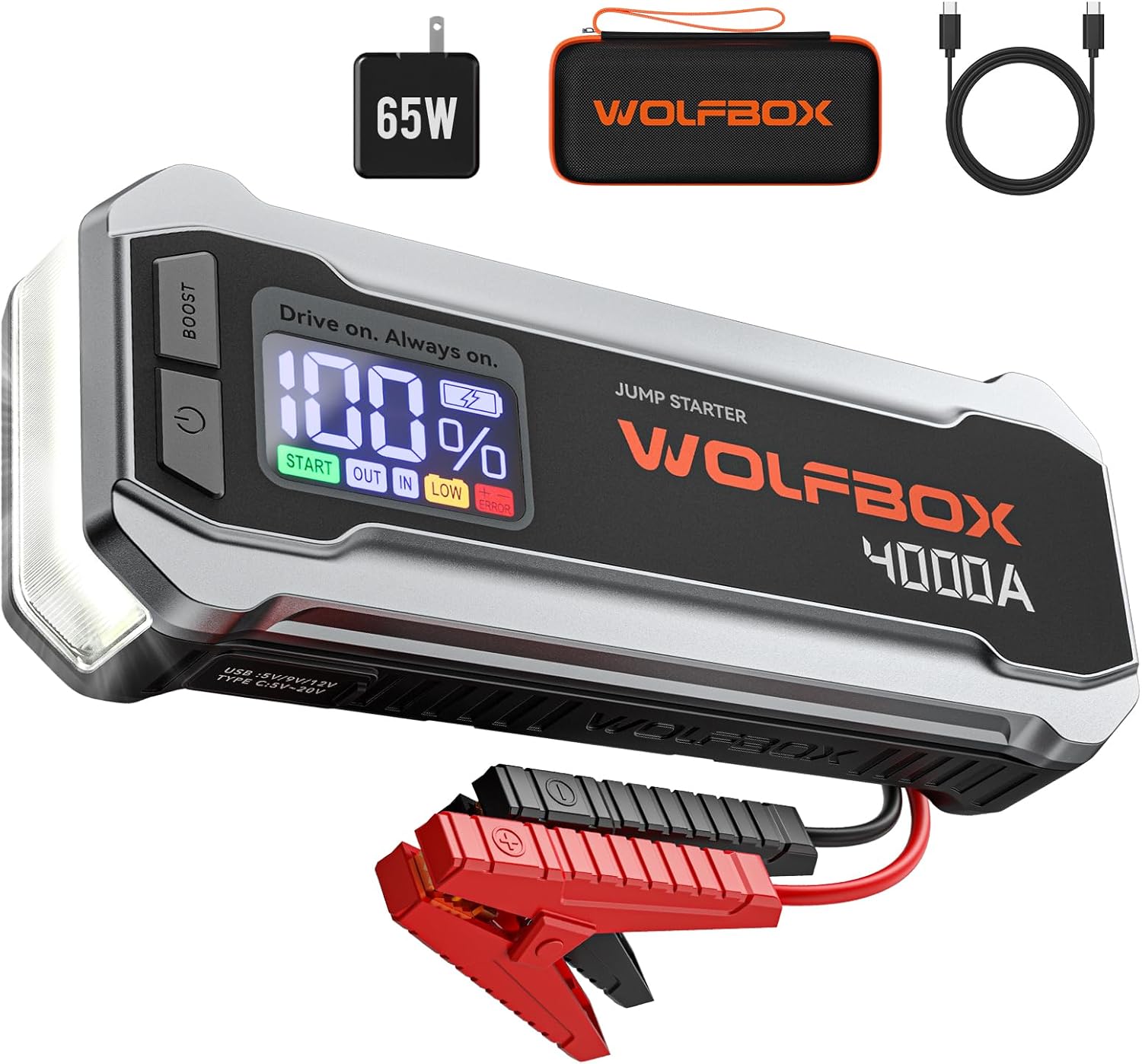
If you’re looking for the best jump starter for SUV duty, my short answer is the WOLFBOX MegaVolt24 — a 4,000-amp unit with a battery big enough to jump a V6 several times over and still charge your phone. I work on my own vehicles at home, mostly Lexus and Toyota, and a jump starter is the one tool I insist every SUV owner keeps in the cargo area. A 3.5L V6 like the one in my RX350 needs more cranking current than a compact car, especially on a cold morning with a five-year-old battery, so the tiny glove-box units that work fine for a Corolla can leave you stranded. This guide covers seven lithium jump starters that will reliably crank an SUV, including a budget pick around $70 and a premium option for people who also tow.
As an Amazon Associate, Top10Great earns from qualifying purchases. This post contains affiliate links, which means we may receive a commission if you buy through our links, at no extra cost to you.
Quick Comparison: Top SUV Jump Starters
| Jump Starter | Best For | Peak Amps / Engine Rating | Price | Link |
|---|---|---|---|---|
| WOLFBOX MegaVolt24 | Best Overall | 4,000A — up to 10L gas/diesel | $$ | Check price |
| GOOLOO GP2000 | Best Budget | 2,000A — up to 8L gas / 6L diesel | $ | Check price |
| NOCO Boost GB70 | Best Premium | 2,000A — up to 8L gas / 6L diesel | $$$ | Check price |
| NOCO Boost X GBX45 | Best Compact for SUVs | 1,250A — half-ton trucks & SUVs | $$ | Check price |
| Fanttik T8 APEX | Best Display & Fast Charging | 2,000A — up to 8.5L gas / 6L diesel | $$ | Check price |
| HULKMAN Alpha85 | Best for Cold Climates | 2,000A — up to 8.5L gas / 6L diesel | $$ | Check price |
| NOCO Boost Plus GB40 | Best Glove-Box Backup | 1,000A — up to 6L gas / 3L diesel | $$ | Check price |
WOLFBOX MegaVolt24 — Best Overall
The MegaVolt24 is the unit I’d hand to any SUV owner who asks. It carries a 4,000-amp peak rating and an 88.8Wh battery — one of the largest in this class — which means multiple jump starts per charge with capacity to spare. TechGearLab made it their top overall pick for 2026 after starting a completely dead V6 three times in a row, with each start using only about 3% of the battery. It recharges via 65W USB-C in a couple of hours and doubles as a fast power bank for a laptop or two phones.
Pros: Enormous 88.8Wh capacity holds a useful charge for months between top-ups; large digital display shows exact battery percentage at a glance; 65W USB-C in and out (wall charger included); rated for engines up to 10 liters, so it will never break a sweat on a V6 or V8 SUV.
Cons: The clamps are stubby, and reviewers regularly mention having to hunt for an angle on batteries with tight terminal clearance — a fair complaint. The flashlight is also mediocre compared to NOCO’s, and the cased kit is trunk-sized, not glove-box-sized.
Who should buy it: Anyone with a mid-size or full-size SUV who wants one device for jump starts, road trips, and power outages.
Check the WOLFBOX MegaVolt24 price on Amazon
GOOLOO GP2000 — Best Budget
Regularly on sale for around $70, the GP2000 delivers 2,000 peak amps and a 37Wh battery, and it’s rated for gas engines up to 8 liters. In independent testing it handled eight consecutive boosts on a 2.5L engine before needing a recharge. For a commuter SUV with a healthy starter, it’s honest value.
Pros: Frequently the cheapest 2,000A unit from a known brand; decent 37Wh battery doubles as a power bank with USB and 12V DC output; enough headroom for any V6 and most V8 SUVs.
Cons: Testers found it struggles on genuinely large engines with high cranking demands, so treat the 8L rating as optimistic. The carrying case is clunky, and the 12V car charging adapter is sold separately.
Who should buy it: Budget-minded owners of 4-cylinder or V6 SUVs who want reliable insurance without paying NOCO prices.
Check the GOOLOO GP2000 price on Amazon
NOCO Boost GB70 Review — Best Premium
Since two of the calendar’s suggestions are NOCO units, here’s my NOCO Boost review for the big one first. The GB70 is the 2,000-amp older brother of the famous GB40, built for 8.0L gas and 6.0L diesel engines. It’s the unit tow-truck operators actually carry: rubberized, IP65-rated, with long heavy-gauge cables and full-size clamps that bite properly onto side-post and recessed terminals — exactly what the WOLFBOX’s stubby clamps can’t do.
Pros: Professional-grade clamps and cable length make connections easy on any battery layout; 400-lumen flashlight with 7 modes is the best in this roundup; proven UltraSafe spark-proof and reverse-polarity protection; starts large-displacement V8s and diesels without drama.
Cons: At about $200 it costs nearly three times the budget pick, and at 5 pounds it’s the heaviest lithium unit here. Amazon reviewers also note it uses an older charging port rather than USB-C, so recharging is slower than the Fanttik or WOLFBOX.
Who should buy it: Owners of large SUVs (Sequoia, LX, Suburban), anyone who tows, or anyone who wants the most durable unit money buys.
Check the NOCO GB70 price on Amazon
NOCO Boost X GBX45 — Best Compact for SUVs
The GBX45 is the sweet spot in NOCO’s newer Boost X line: 1,250 peak amps, 60W USB-C charging in and out, and an IP65 weather rating, in a package barely bigger than the GB40. WIRED named it their best compact pick for 2026. That extra 250 amps over the GB40 is exactly the cushion a V6 SUV wants on a freezing morning.
Pros: Modern fast USB-C recharging (a real upgrade over the GB40’s dated USB-A); enough power for half-ton trucks and turbodiesels; NOCO’s excellent low-profile clamps; compact enough for the door pocket.
Cons: Costs more than some 2,000A competitors, and the battery capacity is modest, so keep it topped up — reviewers who left it untouched for six months found it needed a recharge before it would boost.
Who should buy it: SUV owners who value NOCO build quality but want something smaller and cheaper than the GB70.
Check the NOCO GBX45 price on Amazon
Fanttik T8 APEX — Best Display and Fast Charging
The T8 APEX packs 2,000 peak amps and a 20,000mAh battery rated for 8.5L gas engines, with a bright 3-inch display showing charge and voltage, and 65W two-way USB-C that refills the whole unit from empty in about 90 minutes. It’s IP65 water and dust resistant and feels more premium than its price.
Pros: Fastest recharge time in this roundup; clear display beats indicator lights when you’re troubleshooting at night; 8.5L gas rating covers every SUV on the road; often priced near the GB40 while offering twice the peak amps.
Cons: Amazon reviews show occasional quality-control misses — some buyers received defective units, though Fanttik’s customer service replaced them quickly. The brand also doesn’t have NOCO’s decade-long track record.
Who should buy it: Tech-minded owners who want modern charging and real-time voltage info over legacy brand names.
Check the Fanttik T8 APEX price on Amazon
HULKMAN Alpha85 — Best for Cold Climates
The Alpha85 delivers 2,000 peak amps from a 20,000mAh pack rated for 8.5L gas and 6.0L diesel engines, with a huge 3.3-inch display and 65W fast charging (wall charger included in the current bundle). Its party trick is a pre-heating function that warms the battery in sub-zero temperatures — lithium cells lose real output in the cold, and this is the only unit here that actively fights that.
Pros: Pre-heat mode makes it the most dependable choice for genuinely cold winters; the giant display walks you through the jump with plain-language prompts, great for first-timers; more than 3,000 five-star reviews on Amazon praising the screen and charge speed; excellent build quality and packaging.
Cons: Bulkier than the NOCO compacts, and a handful of Amazon reviewers report units that lost standby charge faster than claimed after a year of trunk storage — check yours quarterly.
Who should buy it: Anyone in snow country, or nervous first-time users who want the device to tell them exactly what to do.
Check the HULKMAN Alpha85 price on Amazon
NOCO Boost Plus GB40 — Best Glove-Box Backup
The GB40 is the best-known lithium jump starter ever made, and at about $99 it’s still a fine buy — with a caveat for SUV owners. Its 1,000-amp rating covers 6.0L gas engines on paper, and it will start a healthy 3.5L V6. But it has less cold-weather headroom than anything else here, which is why I rank it as a backup rather than a primary SUV unit.
Pros: Genuinely pocketable at 2.4 pounds; NOCO’s mature UltraSafe protection and refined clamps; up to 20 starts per charge on small engines; years of proven reliability behind it.
Cons: USB-A-only charging feels dated next to the USB-C competition, and reviewers confirm it can struggle with larger V8s and cold-soaked batteries — the two situations SUV owners care about most.
Who should buy it: Owners of car-based crossovers (RAV4, NX, smaller RX-class engines) who want the smallest serious unit, or as a second starter for the other car.
Check the NOCO GB40 price on Amazon
How to Choose a Portable Jump Starter for a V6 or V8 SUV
Peak amps get the marketing attention, but three other things matter as much. First, match the rating to your engine with margin: a 3.5L V6 starts fine on 1,000A in warm weather, but batteries deliver less current and oil thickens in the cold, so I recommend 1,500–2,000A minimum for any portable jump starter a V6 SUV will rely on, and 2,000A+ for V8s. Second, battery capacity (Wh) determines how many attempts you get and how well the unit survives months of neglect in the trunk — bigger is better, and a percentage display beats four vague LEDs. Third, clamp and cable quality is the difference between an easy connection and a frustrating one; SUV batteries often sit deep in the engine bay with plastic covers, and short stubby clamps genuinely struggle there. Finally, insist on spark-proof, reverse-polarity-protected designs from a brand with a warranty — every unit above qualifies, but plenty of $30 no-name units don’t. USB-C recharging and power-bank output are worthwhile conveniences; a built-in air compressor is nice but usually compromises the core tool.
On my 2008 RX350, the battery sits right up front with easy terminal access, so even stubby clamps work — but the 2GR-FE V6 has a high compression starter draw, and a marginal battery on a 40°F morning is exactly when a 1,000A unit starts sounding hesitant.
FAQ: Jump Starting an SUV
How many amps do I need to jump start an SUV? For most V6 SUVs, 1,000 peak amps is the bare minimum and 1,500–2,000A is the comfortable range. V8s and diesels should use 2,000A or more. Cold weather can cut effective output significantly, so buy headroom.
Can a portable jump starter damage my car’s electronics? A quality unit with spark-proof and reverse-polarity protection is very unlikely to cause damage — it delivers current more cleanly than jumper cables from a running car. The risk comes from cheap units without protection circuits.
How long does a lithium jump starter hold its charge? Most hold a usable charge for 6–12 months in storage, but heat and cold accelerate self-discharge. Check it every 3 months and recharge at 50–75%. Big-battery units like the MegaVolt24 tolerate neglect best.
Is it safe to leave a jump starter in the car in summer? Short-term, yes; long-term storage above 122°F (50°C) degrades lithium cells and is a safety risk. In hot climates, keep it in the cabin rather than the trunk, or bring it inside during heat waves.
Can I use a jump starter to charge my phone? Yes — every unit in this guide doubles as a USB power bank, and the WOLFBOX, Fanttik, and HULKMAN offer 65W USB-C that will fast-charge a laptop. Just remember every watt-hour you use on devices is one you can’t use to crank an engine.
Verdict
The WOLFBOX MegaVolt24 is the best jump starter for SUV owners in 2026: more power than you’ll ever need, a battery that shrugs off months of trunk storage, and genuine power-bank utility. If you just want dependable insurance for the least money, the GOOLOO GP2000 around $70 covers any V6 SUV with a healthy starter. And if you tow, drive something with a big V8, or simply want the toughest unit made, spend up for the NOCO GB70. Whichever you choose, charge it today and set a calendar reminder for October — a jump starter with a dead battery is just extra cargo weight.