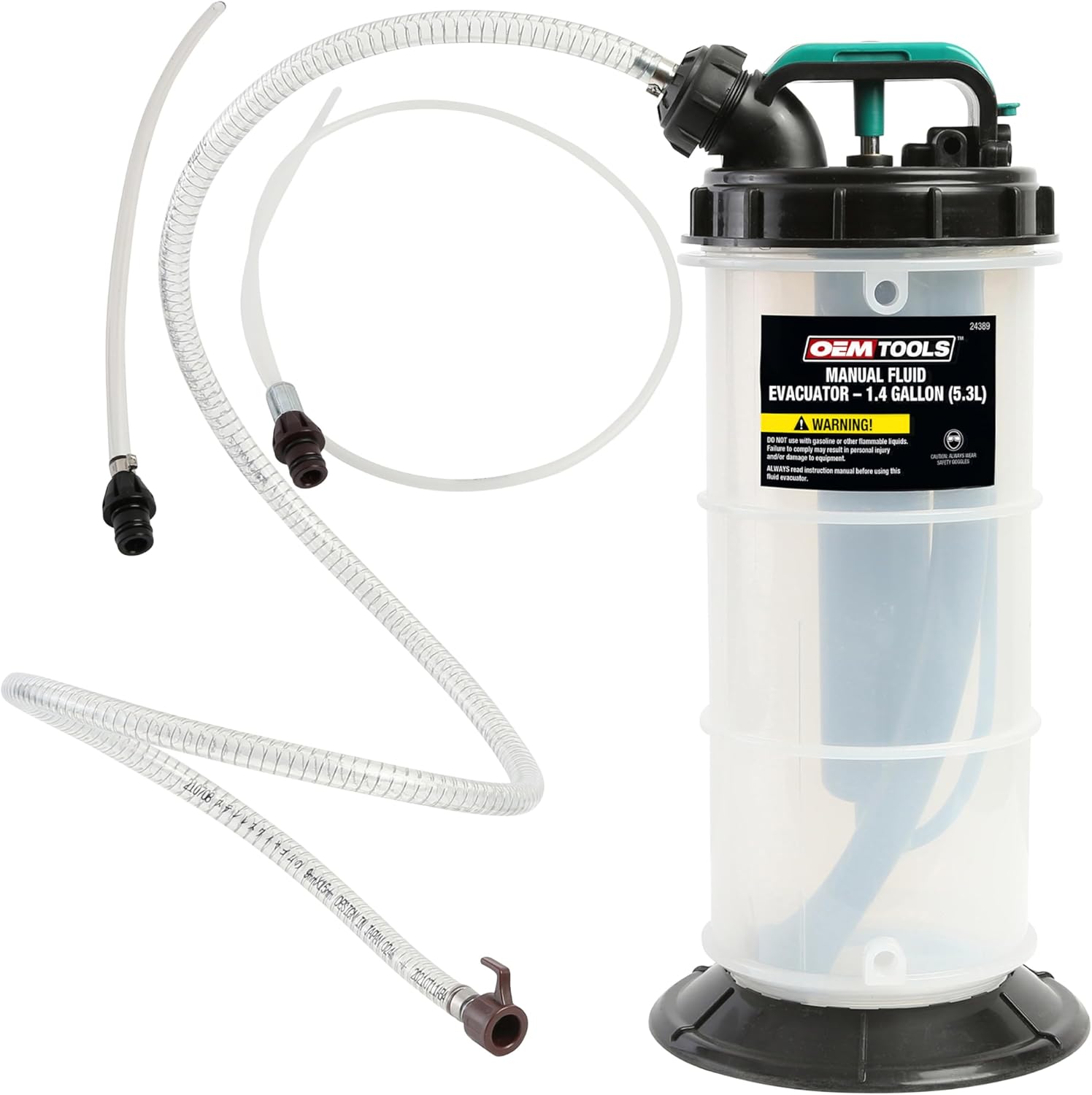
If you want the best oil extractor pump for topside oil changes, my short answer is the OEMTOOLS 24389 Manual Fluid Extractor — it’s the one I reach for most, and it’s the easiest to live with if you’ve never done a topside change before. No ramps, no drain plug, no stripped crush washer, no oil running down your forearm. This guide covers six extractors I’d actually use, what they cost, and the honest downsides Amazon reviewers keep running into.
As an Amazon Associate, Top10Great earns from qualifying purchases. This post contains affiliate links, which means we may receive a commission if you buy through our links, at no extra cost to you.
Oil Extractor Pump Comparison Table
| Product | Best For | Key Spec | Price | Link |
|---|---|---|---|---|
| OEMTOOLS 24389 | Best Overall | 5.3L manual, auto shutoff, 5-ft hose | $$ | Check price |
| HORUSDY 6.5L | Best Budget | 6.5L pneumatic/manual, 5 tube sizes | $ | Check price |
| Mityvac 7201 | Best Premium | 8.8L, extracts AND dispenses, auto shutoff | $$$ | Check price |
| EWK 6.5L Pneumatic | Fastest (with compressor) | 1.8L/min on shop air, manual backup mode | $$ | Check price |
| Airpower America 5060TS Topsider | Most Durable / Boats | 8-qt steel tank, pump-and-walk-away | $$ | Check price |
| Pela PL-6000 | Easiest to Monitor | 6L see-through tank with level markings | $$ | Check price |
Best Overall: OEMTOOLS 24389 Manual Fluid Extractor (5.3L)
The OEMTOOLS 24389 is the extractor I recommend to anyone doing their first topside oil change. It’s a one-piece 5.3-liter (1.4-gallon) reservoir with a built-in hand pump: you snake the tube down the dipstick hole, give the handle a dozen strokes, and warm oil starts flowing on its own. The automatic overflow shutoff valve stops suction before the tank overfills, which is exactly the kind of idiot-proofing you want when you’re doing this in the driveway. It sits around 4.5 stars from over 3,800 Amazon ratings, and it also pulls transmission fluid, coolant, and power steering fluid.
Pros: the oversized pump handle takes little effort and primes in a few strokes; the 5-foot main hose plus a 41-inch dipstick adapter reaches deep pans; the single-piece tank means no seams to leak on your garage floor; and the overflow shutoff genuinely prevents the classic “I wasn’t watching” spill.
Cons: Amazon reviewers regularly note the included tubes are too short for trucks and some larger engines, and the tall, narrow base is easy to tip over if you bump the hose mid-extraction. A smaller group reports the pump losing suction after a season of use.
Who should buy it: anyone with a car or mid-size SUV who wants the simplest, cleanest oil change possible. One honest note for my fellow RX owners: the RX350’s 2GR-FE V6 holds about 6.1 liters with a filter change, so the 5.3L tank means pausing once to empty it — or stepping up to one of the 6.5L+ units below. Check the current price on Amazon.
Best Budget: HORUSDY 6.5L Pneumatic/Manual Oil Extractor
The HORUSDY 6.5L is the value play in this category — usually the cheapest full-size extractor on the page, yet it works both manually and off an air compressor, and the 6.5-liter tank swallows a full V6 oil change without emptying mid-job. It ships with five different tube diameters plus a flex hose and even a brake-bleeding hose, which is more accessory coverage than extractors costing twice as much. On shop air it claims 1.8L/min, so a warm four-cylinder is empty in a couple of minutes.
Pros: lowest cost per liter of capacity here; dual pneumatic/manual operation; five tube sizes means you’ll find one that actually reaches the bottom of your pan; big enough for the RX350’s 6.1 liters in one go.
Cons: the plastic fittings and tube connectors are where the budget shows — reviewers report the small-diameter tubes kinking or popping off the main hose if you rush; and the printed instructions are minimal, so plan on watching a video for first setup.
Who should buy it: the DIYer who changes oil twice a year and wants the job done without spending real money. Check the current price on Amazon.
Best Premium: Mityvac 7201 Fluid Evacuator Plus
The Mityvac 7201 has been the benchmark since 2006, with well over 4,300 Amazon ratings for good reason. The 8.8-liter (2.3-gallon) chemical-resistant polyethylene tank is nearly double the capacity of most rivals, and a push button switches it between evacuate and dispense — meaning it doesn’t just suck old gear oil out of a differential, it pumps the new fluid back in. That second function alone justifies the price if you service diffs or transmissions. It also has automatic overflow prevention and a quick-drain spout.
Pros: extract-and-dispense versatility no one else here matches; holds vacuum impressively long — owners report it still pulling oil ten minutes after they stopped pumping, while cheap units lose their seal in two or three; huge capacity handles back-to-back oil changes; rust-proof tank will outlast your car.
Cons: it’s the most expensive unit in this guide, and reviewers note the included dipstick tubes run short for trucks and larger SUVs — surprising given the tank size.
Who should buy it: the home mechanic who maintains two or more vehicles, or anyone who also wants to do differential and transmission fluid swaps topside. Check the current price on Amazon.
Fastest With a Compressor: EWK 6.5L Pneumatic/Manual Oil Extractor
If you already own an air compressor, the EWK 6.5L is the speed pick. Hook it to shop air and it pulls 1.8 liters per minute — a warm four-cylinder is done in about five minutes, no pumping at all. No compressor handy? It still works as a regular manual extractor. It carries roughly 4.4 stars across 3,500+ ratings, and the eagle-mouth pour spout with a locking cap makes emptying it less messy than most.
Pros: genuinely fast on air power; manual backup mode means it’s never useless away from the garage; heat-resistant polypropylene tank; the sealing cap keeps sloshing oil contained while you carry it to the recycling jug.
Cons: the two extension hoses are a known weak point — a recurring Amazon complaint is that they don’t want to stay connected to the main tube; and EWK warns against fluids over 104°C (220°F), which can deform the tank, so let the engine cool a few minutes after a highway run.
Who should buy it: compressor owners and anyone who values speed over lowest cost. Manual-only users will find pumping it slower than the OEMTOOLS. Check the current price on Amazon.
Most Durable: Airpower America 5060TS Topsider
The Topsider is the old-school choice — a squat 8-quart steel tank that looks like a moonshine still and survives being kicked around a boatyard for decades. Its party trick: you give it around 40 pump strokes to build vacuum, then walk away while it drains the engine on its own over eight to ten minutes. No continuous pumping, no electricity, no compressor. The wide 12-inch base is very hard to tip over, and it rates about 4.1 stars from 2,200+ reviews.
Pros: solid steel construction outlasts every plastic tank here; pump-and-walk-away operation; wide stable base; compact enough to stow in a boat or RV.
Cons: reviewers warn the suction hose can disconnect and drop into the oil filler if you’re careless, and over-tightening the pump cap distorts the seal so it won’t pull vacuum — snug, not gorilla-tight. The awkward side-mounted pour port also makes emptying it less precise than a proper spout.
Who should buy it: boaters, RV owners, and buy-it-once types who don’t mind slower extraction. Check the current price on Amazon.
Easiest to Monitor: Pela PL-6000
The Pela 6000 is a boater favorite that deserves more attention from car people. It’s a simple 6-liter vacuum unit — ten to twenty pump strokes and it drains on its own — but the tank is translucent with calibrated level markings on the wall. That sounds minor until you realize it answers the question every extractor user has: “did I actually get all 6.1 liters out?” You watch the level rise and know exactly when the pan is empty.
Pros: see-through calibrated tank takes the guesswork out; lightweight at about 4.5 lbs; removable pump and pour spout for clean storage and disposal; enough capacity for most V6 engines in one pull.
Cons: the plastic tank can crack or collapse if you keep pumping aggressively past full vacuum — a real complaint in reviews — and the narrow tube is slow with thick, cold oil, so always extract warm.
Who should buy it: detail-oriented owners who want visual confirmation of every liter removed. Check the current price on Amazon.
How to Choose an Oil Extractor Pump: Buying Guide
Capacity first. Your extractor’s tank must hold your engine’s full oil capacity in one go, or you’ll be emptying it mid-job with a tube dripping oil. A four-cylinder needs 4–5 liters; my RX350’s V6 takes 6.1 liters with the filter, so a 6.5L tank is the practical minimum for V6 SUVs. When in doubt, size up.
Power source second. Manual extractors work anywhere and cost less; pneumatic units are far faster but need a decent compressor; 12V electric pumps exist but are the weakest category — most need a separate catch container and struggle with other fluids. For most home garages, manual or pneumatic/manual hybrid is the right call.
Spill protection matters more than you think. An automatic overflow shutoff valve (OEMTOOLS, Mityvac) is the single best feature on any extractor. A proper pour spout and a sealing cap are next — you still have to carry 12 lbs of used oil to a recycling jug, and that’s when most spills happen.
One honest limitation: a topside extraction pulls the oil, but on many cars the filter still lives underneath. On my 2008 RX350 the cartridge filter housing is under the engine, so I still reach under for two minutes with a filter wrench — no jack needed, but it’s not a zero-crawling job on every vehicle. Check where your filter sits before assuming a fully stand-up oil change.
Oil Extractor FAQ
Does an oil extractor get all the oil out?
Almost all of it. Extracting through the dipstick tube with warm oil leaves a few tablespoons at most in a flat-bottomed pan — comparable to what a drain plug leaves clinging to the pan walls. Wiggle the tube to the lowest point and wait for air bubbles in the line before calling it done.
Will an oil extractor damage my engine?
No. The vacuum these pumps generate is far too weak to harm anything, and the tube only touches the inside of the dipstick passage and the oil pan. Loosening the oil fill cap during extraction equalizes pressure and speeds things up.
How long does a topside oil change take?
With warm oil, five to ten minutes of extraction for most engines — faster on pneumatic mode, slower on cold or high-mileage thick oil. My full routine including the filter swap runs about 20 minutes.
Can I use an oil extractor for transmission fluid or coolant?
Most manual extractors here handle transmission fluid, power steering fluid, gear oil, and coolant. Never use a standard extractor for gasoline or any flammable liquid — that requires a pump specifically rated for fuels.
Where do I dispose of the used oil?
Pour it into the empty jugs your new oil came in and drop them at any auto parts store — AutoZone, O’Reilly, and Advance all take used oil free. Most extractors’ pour spouts fit a jug funnel cleanly.
Verdict
For most people, the OEMTOOLS 24389 is the best oil extractor pump: proven, spill-proofed, and easy to use the very first time. If you’re watching the budget — or you drive a V6 that holds more than 5.3 liters — the HORUSDY 6.5L gets you a bigger tank and air-power capability for less money. And if you want one tool that extracts and refills every fluid in the driveway, spend up on the Mityvac 7201. Whichever you pick, do it with warm oil and you’ll never miss the drain plug.