The best jump starter for Ram 1500 owners who do their own work is the NOCO Boost HD GB70, and it is the one I keep in the back of the cab. It has enough margin for the 5.7 HEMI and the Hurricane I6, the clamps are long enough to reach the battery past the fender, and it is strictly 12 volt — which, as you will see below, matters more on this truck than on most. I have broken the picks down by engine, because a 3.6L Pentastar and a 3.0L EcoDiesel are not asking the same thing of a jump starter, and I have included the battery locations and the one warning in Ram’s own manual that most roundups skip.
As an Amazon Associate, Top10Great earns from qualifying purchases. This post contains affiliate links, which means we may receive a commission if you buy through our links, at no extra cost to you.
How to pick the best jump starter for Ram 1500 engines
Start with the battery Ram fitted, not with the peak-amp number on the box. Fitment data for the 1500 lines up like this:
- 3.6L Pentastar V6 and 5.7L HEMI V8 — group 94R (H7), roughly 730–850 CCA from the factory depending on year and whether the truck got a flooded or AGM battery.
- 3.0L EcoDiesel (2014–2018, 2020–2023) — group 49 (H8), AGM required, 800 CCA factory. Plenty of owners step up to a 950 CCA H8 AGM in the stock tray.
- 3.0L Hurricane twin-turbo I6 (2025+) — the aftermarket fitment guides have not settled on a group number yet. Check the label on your own battery before you buy anything sized to it.
A healthy battery in that range pulls somewhere between about 500 A on a warm Pentastar and well over 1,000 A on a cold EcoDiesel during the crank. A jump pack’s advertised “peak amps” is a fraction-of-a-second surge figure, not sustained cranking current, so the practical rule on this truck is to buy roughly double the number you think you need. On a gas 1500 that means 1,500–2,000 A peak. On the EcoDiesel it means 2,000 A as a floor and 3,000 A if you live somewhere that gets properly cold.
Comparison table
| Product | Best for | Key spec | Price | Link |
|---|---|---|---|---|
| NOCO Boost HD GB70 | Best overall | 2,000 A peak; 7.0L gas / 4.5L diesel | $$ | Check price |
| GOOLOO GP4000 | Best budget | 4,000 A peak claim; 24,000 mAh | $ | Check price |
| NOCO Boost Pro GB150 | Best premium / EcoDiesel | 3,000 A peak; 10.0L gas / 8.0L diesel | $$$ | Check price |
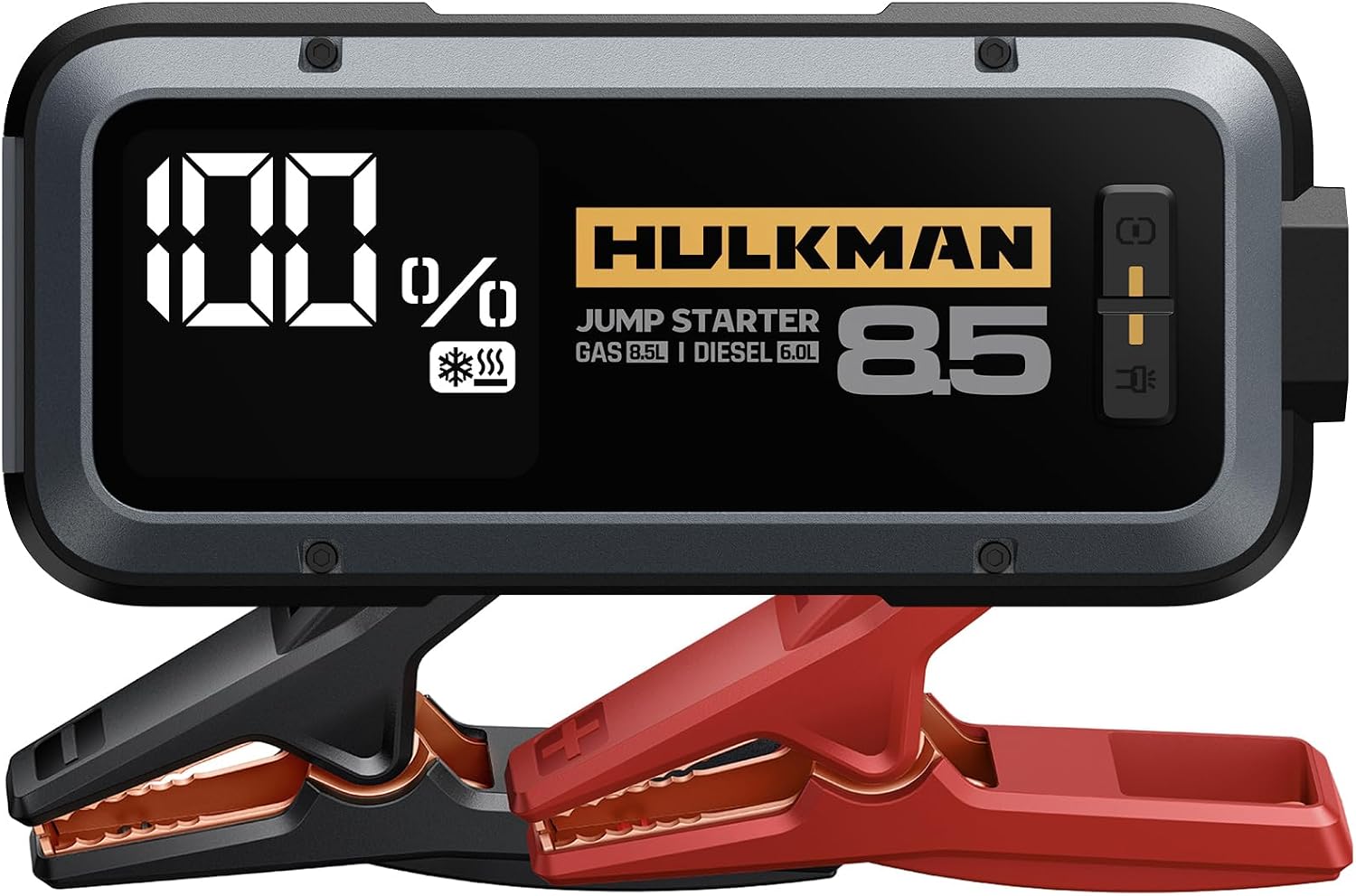
| HULKMAN Alpha 85S | Deep cold | 2,000 A; −40°F pre-heat; 74 Wh | $$ | Check price |
| NOCO Boost X GBX55 | Glovebox size | 1,750 A; 60 W USB-C in/out | $$ | Check price |
NOCO Boost HD GB70 — best overall for the HEMI and Hurricane
A 2,000 A lithium pack rated for 7.0L gas and 4.5L diesel engines. On a 5.7 HEMI with a tired 94R battery, that is the right amount of headroom: enough to crank without being so large that you stop carrying it.
Why it works on this truck:
- The cables are long enough and flexible enough to reach the battery from where you can actually set the pack down. On a 2019+ 1500 the battery sits under the hood on the driver’s side, and short-lead packs leave you balancing them on the fender.
- It is a 12 V-only unit with no selectable voltage mode — which matters, because Ram’s manual explicitly forbids a booster source above 12 volts on this truck.
- Reverse-polarity protection and spark-proof clamps, so a wrong-way clamp on a dark shoulder is an error message rather than a repair bill.
- The 400-lumen light is genuinely bright enough to work by, and it holds charge in storage well enough to be worth leaving in the truck.
Honest cons: it is a 2 lb-plus brick with an awkward shape, and recharging it over its micro-USB-era input is slow — several hours from flat. Owners who want to top it up from a laptop charger should look at the GBX55 instead.
Buy it if: you have a HEMI, a Hurricane, or a Pentastar and want one pack that is not borderline.
GOOLOO GP4000 — best budget pick
The GP4000 advertises 4,000 A peak and a 24,000 mAh pack for roughly half the price of the NOCO. Take the headline amp number with salt — the testing standard behind these figures is not consistent across brands — but the capacity is real, and in practice it cranks a 5.7 HEMI without drama.
Pros: the price is the point; the large internal battery means several jumps on one charge rather than one nervous attempt; it doubles as a usable power bank; and the display tells you actual state of charge instead of four LED bars.
Honest cons: build quality is a clear step below NOCO — the clamp jaws are softer and the case flexes — and the model line is confusing, with GP4000, GP4000 Plus and GT4000S variants at different prices. Check you are buying the one you think you are.
Buy it if: this is insurance you hope never to use, and you would rather spend the difference on a battery.
NOCO Boost Pro GB150 — best premium, and the right call for an EcoDiesel
3,000 A, rated to 10.0L gas and 8.0L diesel. This is overkill on a Pentastar and about right on a cold 3.0L EcoDiesel, where the group 49 AGM is asking for over 1,000 A and a half-charged 2,000 A pack starts to feel marginal.
Pros: heavy 2 AWG clamps that grip a dirty top post properly; it will crank a diesel repeatedly rather than once; the 12 V output runs accessories; and it holds up to being stored in a truck box through a winter.
Honest cons: it is big, heavy and expensive — roughly triple the GP4000 — and gas-engine owners genuinely do not need it. Several owners also note it is too bulky for under-seat storage in a crew cab.
Buy it if: you run the EcoDiesel, tow, or park outside in a cold climate.
HULKMAN Alpha 85S — best for deep cold
A 2,000 A, 74 Wh pack whose point of difference is a pre-heat function that warms its own cells before it tries to deliver current, rated down to −40°F. Lithium packs lose output in the cold exactly when you need them, so a pack that conditions itself first is solving the real problem rather than printing a bigger number on the case.
Pros: the pre-heat genuinely changes behaviour below about 0°F; the 3.3-inch display shows voltage and charge clearly in the dark; rated for up to 8.5L gas and 6.0L diesel, so it covers every 1500 engine; and it charges over USB-C.
Honest cons: pre-heating takes time and eats charge, so a half-empty pack in deep cold may not have both; and the Alpha 85 and Alpha 85S look nearly identical in listings while only the S model has the pre-heat, which is an easy and annoying mistake to make.
Buy it if: your truck lives outside north of roughly the 40th parallel.
NOCO Boost X GBX55 — best compact option
1,750 A in a package that fits a Ram 1500’s centre console, with 60 W USB-C in and out — it recharges itself from a laptop charger in well under an hour.
Pros: fast recharge means it is actually topped up when you need it; small enough that it stays in the truck; the USB-C power delivery makes it a legitimate phone and laptop bank; same 12 V-only safety design as the GB70.
Honest cons: 1,750 A is adequate rather than generous on a cold HEMI, and the short clamp leads are a real limitation on a full-size truck — you will be resting it on the fender liner.
Buy it if: you want one device that charges your phone and starts the truck.
Where the battery is, and the mistake to avoid
On fourth-generation trucks (2009–2018) the battery sits at the front of the engine compartment behind the left headlight, with the positive post under a protective cap you flip up. On fifth-generation trucks (2019+) it is under the hood on the driver’s side; eTorque trucks have a plastic cover over it.
Here is the part the roundups get wrong. If your 1500 has eTorque, there is a second battery — a 48 volt, roughly 430 Wh lithium pack of twelve pouch cells, about 30 lb, mounted against the cab’s rear wall behind the rear seat. It feeds the belt-driven motor-generator and contains the DC-DC converter that charges your 12 V battery. It does not crank the engine, and you never connect a jump pack to it. A cold no-start on an eTorque truck is almost always the ordinary 12 V battery under the hood. Owners have replaced 48 V packs over what turned out to be a dead starting battery.
And the EcoDiesel does not come with twin batteries, whatever you have read. The 1500 EcoDiesel uses one larger group 49 AGM; dual batteries are a heavy-duty Cummins arrangement on the 2500 and 3500. As one owner puts it bluntly on the Ram diesel forums: his EcoDiesel has only one battery.
Buying guide: what actually matters on a Ram 1500
12 volts, full stop. Ram’s manual states plainly that you should not use a portable booster pack or any booster source with a system voltage greater than 12 volts, because of the risk to the battery, starter, alternator and electrical system. Some large boost boxes offer a 24 V mode for heavy equipment. Do not buy one for this truck, and if you already own one, never let it select 24 V.
Where the negative clamp goes. Ram’s procedure says to connect the negative lead to a good engine ground — not to the negative post of the discharged battery. Bare metal on the engine or a cylinder head works, and fifth-gen trucks have painted factory ground lugs on the fender beside the battery, near the hood strut. They are not labelled, which is why people miss them.
Cable length over peak amps. A full-size truck engine bay is wide and the battery is off to one side. A pack with 12-inch leads forces you to perch it somewhere it can slide off. Longer, more flexible cables are worth more in practice than another 500 A on the box.
Cold de-rates everything. A lithium pack at 10°F delivers noticeably less than its room-temperature rating, and so does your battery. That is the real argument for buying bigger than the arithmetic suggests, and the argument for a pre-heating pack if you park outside.
Drive it afterwards. Once it is running, drive for 20–30 minutes. An AGM battery will not meaningfully recover at idle, and a truck that needed a jump once will need one again tomorrow if you shut it off after five minutes.
FAQ
How many amps do I need to jump start a Ram 1500?
For the 3.6L Pentastar, 1,000–1,500 A peak is enough. For the 5.7L HEMI or the Hurricane I6, buy 1,500–2,000 A. For the 3.0L EcoDiesel, start at 2,000 A and prefer 3,000 A in cold climates.
Can you jump start a Ram 1500 with eTorque?
Yes, exactly like a non-eTorque truck: jump the 12 V battery under the hood. The 48 V pack behind the rear seat is not part of starting and should never be connected to a jump pack.
Does a Ram 1500 EcoDiesel have two batteries?
No. The 1500 EcoDiesel has a single group 49 (H8) AGM battery, 800 CCA from the factory. Factory dual-battery setups belong to the Cummins-powered 2500 and 3500.
Where is the battery on a Ram 1500?
2009–2018: front of the engine compartment, behind the left headlight, positive post under a cap. 2019 and newer: under the hood on the driver’s side, with a plastic cover on eTorque trucks.
Can a jump starter damage my Ram’s electronics?
A 12 V pack with reverse-polarity protection, used on a battery that is not frozen, is low risk. The two things that do cause damage are exceeding 12 volts and clamping backwards, which is why the safety features are worth paying for.
Verdict
For most Ram 1500 owners the NOCO Boost HD GB70 is the right buy: enough capacity for the HEMI and the Hurricane, cables that reach, and no 24 V mode to get you in trouble. If you want to spend less, the GOOLOO GP4000 will crank the truck for roughly half the money, with a build quality you can feel the difference in. EcoDiesel owners and anyone parking outside in a hard winter should step up to the NOCO Boost Pro GB150 or the pre-heating HULKMAN Alpha 85S.
Related guides
- Best Jump Starters for the Ford F-150 (EcoBoost, 5.0L V8 & PowerBoost)
- Best Jump Starters for the Toyota Tundra (5.7L & 3.4L V6 Tested Picks)
- Best Portable Jump Starters for SUVs: Tested Picks for 2026
- Best Battery Maintainers & Trickle Chargers for Lexus RX (2026)