If you want the short version: the best jump starter for a Ford F-150 is the NOCO Boost HD GB70. It’s 2,000 amps, rated to 8.0L of gasoline engine, and it has the one feature that actually matters on a modern F-150 — a manual override that forces a boost when the truck’s AGM battery has dropped too low for the pack to detect it automatically. I’ve written this guide around the 13th and 14th generation trucks (2015 onward), because that’s where the AGM-plus-stop/start combination makes jump starting behave differently than it used to. If you’re on a budget, skip to the GOOLOO GP4000 and save yourself about $130.
As an Amazon Associate, Top10Great earns from qualifying purchases. This post contains affiliate links, which means we may receive a commission if you buy through our links, at no extra cost to you.
Quick comparison: the best jump starter for Ford F-150 owners
| Model | Best for | Key spec | Price | Link |
|---|---|---|---|---|
| NOCO Boost HD GB70 | Best overall | 2,000A, to 8.0L gas | $$ | Check price |
| GOOLOO GP4000 | Best budget | 4,000A peak, 24,000mAh | $ | Check price |
| WOLFBOX MegaVolt24 MV24 | Best premium | 24V/12V dual voltage | $$$ | Check price |
| HULKMAN Alpha 85 | Cold climates | 2,000A, heated battery | $$ | Check price |
| NOCO Boost X GBX55 | Fastest recharge | 1,750A, 60W USB-C PD | $$ | Check price |
| NOCO Boost Plus GB40 | Compact glovebox backup | 1,000A, to 6.0L gas | $ | Check price |
What your F-150 actually needs to crank
Before the product sections, the numbers that decide this. Ford has put five very different powertrains in recent F-150s, and they do not all pull the same current:
- 3.3L Ti-VCT V6 — roughly 500–650A, group H6 or H7 AGM
- 2.7L EcoBoost V6 — roughly 550–700A, group H7 or H8 AGM
- 3.5L EcoBoost V6 — roughly 650–800A, group H8 AGM
- 5.0L Coyote V8 — roughly 600–800A, group H8 AGM
- 3.5L PowerBoost hybrid — similar to the 3.5L EcoBoost on the 12V side
Every one of those sits under 1,000A, so on paper even the small GB40 clears it. The reason I still recommend going bigger is not the engine — it’s the battery chemistry. Ford fits AGM batteries to anything with stop/start, and AGM fails differently from flooded lead-acid: it holds respectable voltage right up until it collapses, and once it’s below about 10V many jump packs refuse to engage because they cannot detect a battery on the clamps at all. That’s where 2,000 amps and a manual override earn their money, and it’s the most common complaint I see on f150forum and f150gen14.
Where the battery is — and the PowerBoost trap
On a conventional F-150 the AGM battery is under the hood on the driver’s side. On 14th-gen trucks there’s often a plastic cover over the positive post that flips open. Red clamp goes straight to the positive post; black clamp goes to the marked chassis ground stud on the inner fender, not to the negative post.
PowerBoost owners, read this bit. The hybrid F-150 has three batteries: the 12V main under the hood, a 12V auxiliary under the right-hand rear seat, and the high-voltage hybrid pack. The one you jump is the 12V main under the hood, using the two accessible prongs — exactly like a non-hybrid truck. The auxiliary under the rear seat supports incidental loads while the main battery is briefly isolated during a crank event; it is not your jump point. And the high-voltage pack is never something you touch with a jump pack. Owners on f150gen14 have found out the hard way that a PowerBoost with a bad 12V will not start no matter how healthy the hybrid system is.
On a Lightning, the 12V low-voltage battery lives in the frunk behind the trim panels — the usual culprit when the truck “won’t wake up.” A standard 12V pack revives it normally.
NOCO Boost HD GB70 — best overall
The GB70 is a 2,000-amp lithium pack rated for gas engines up to 8.0L. The largest engine Ford puts in an F-150 is the 5.0L Coyote, so you’re buying real headroom rather than scraping the ceiling — which matters more than it sounds, because peak output falls as the pack’s own charge and the temperature drop.
What’s good:
- Manual override forces a boost when the AGM is too flat for the pack to auto-detect — the specific failure mode that strands F-150 owners.
- Around 40 jump starts per charge, so it tolerates being forgotten in a toolbox between uses.
- Heavy, properly-gauged clamps and cables that reach an under-hood post without stretching.
- 400-lumen light with an SOS mode that’s genuinely usable roadside.
What’s not: there’s no wall charger in the box, only a USB-C cable, which stings at the price. And there’s a documented pattern of charge-retention complaints across NOCO’s range — owners reporting a GB70 going flat within a couple of weeks of sitting, and GBX-series units refusing to accept a charge after light use. Top it up every three months and check it before winter.
Buy it if you want one pack that will outlast the truck and never leave you wondering whether it has enough punch. At about $200 it’s the default answer for a reason. Check current price.
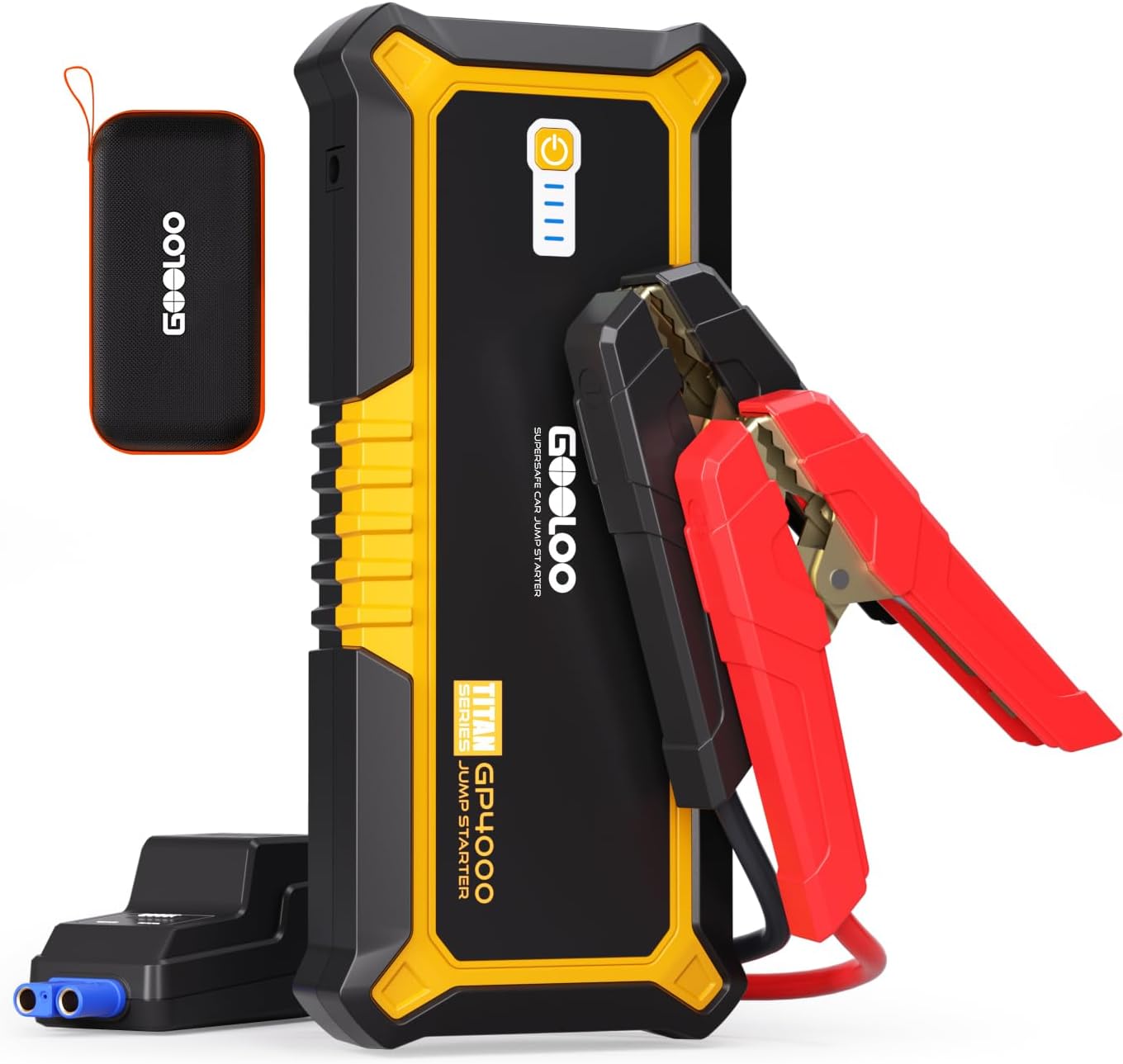
GOOLOO GP4000 — best budget
Around $70–100 depending on the week, with a 4,000A peak claim and a 24,000mAh cell. Treat the headline amperage as marketing — peak figures across brands aren’t measured the same way — but the real-world performance on a V6 or V8 F-150 is not in doubt.
What’s good:
- Roughly a third the price of the GB70 while still starting any F-150 engine.
- Large battery means it doubles as a decent power bank on a job site.
- Owners routinely report multi-year service life from GOOLOO packs.
What’s not: the clamps and cables are noticeably cheaper than NOCO’s, and the pack is bulky for what it does. Quality control is less consistent — it’s the kind of product where you should test it in the driveway the week it arrives rather than discovering a dud in a car park.
Buy it if this is insurance you hope never to use and you’d rather not spend $200 on it. Check current price.
WOLFBOX MegaVolt24 MV24 — best premium
Dual-voltage 24V/12V, which is overkill for an F-150 alone but makes sense if the truck shares a driveway with a diesel tractor, a skid steer, or a Super Duty.
What’s good:
- Handles 24V equipment as well as your truck — one pack for a mixed fleet.
- Substantially more cable and clamp than you get at the $70 tier.
- Large reserve capacity for repeated attempts in cold weather.
What’s not: heavy and physically large, so it doesn’t live in a door pocket. It’s also the one product here where I could not confirm a current price at the time of writing, so check before you commit.
Buy it if you maintain more than just the F-150. Otherwise the GB70 does the truck job for less. Check current price.
HULKMAN Alpha 85 — best for cold climates
2,000A with a heated battery circuit that pre-warms the cell before it delivers current. If your F-150 lives somewhere that sees genuine sub-zero mornings, that feature is the reason to look here instead of at NOCO — lithium packs lose output sharply in the cold, right when a tired AGM needs the most help.
What’s good:
- Heated cell maintains output when a comparable pack would be struggling.
- Clear colour display showing actual state of charge rather than four ambiguous LEDs.
- 4.7-star average across 13,000-plus ratings, the highest in this group.
What’s not: pricing has been volatile — it has sat around $110 but has spiked far higher during demand surges, so it is worth watching rather than buying on impulse. The heating function also consumes charge, which means it wants topping up more often than a GB70 if you store it in the truck.
Buy it if you’re in the northern states or Canada. Check current price.
NOCO Boost X GBX55 — fastest recharge
1,750A with 60W USB-C Power Delivery in both directions, so it refills in roughly an hour rather than most of a day. If your pack gets used, then forgotten, then needed again, that turnaround is worth more than amps you’ll never call on.
What’s good:
- Full recharge in about an hour over USB-C PD.
- Charges a phone fast enough to be a real power bank, not a token one.
- Same manual override behaviour as the GB70.
What’s not: this is the family with the most charge-acceptance complaints — several owners report GBX units that stopped taking a charge after only a couple of uses. Test it early. At around $175 it’s also close enough to GB70 money that the extra amps are tempting.
Buy it if fast turnaround matters more than maximum output. Check current price.
NOCO Boost Plus GB40 — best compact backup
1,000A, rated to 6.0L gas, around $100 and frequently discounted. With over 120,000 ratings at 4.6 stars it is one of the most reviewed jump starters on the market.
What’s good:
- Small enough to live under a rear seat permanently.
- Still comfortably clears every F-150 engine’s cranking requirement on paper.
- Cheapest route into NOCO’s build quality and safety behaviour.
What’s not: 1,000A is the least margin here, and margin is exactly what you want when a flat AGM is fighting you at 15°F. Several F-150 owners have reported the GB40 needing two or three attempts on a deeply discharged truck where a GB70 fired first time. Short cables, too.
Buy it if you want a secondary pack, or you drive a 3.3L V6 in a mild climate. Check current price.
Buying guide: what matters on an F-150 specifically
Peak amps are the least useful number on the box. Manufacturers measure “peak” differently and nobody audits it, so a 4,000A claim from one brand and 2,000A from another may deliver nearly identical cranking current. Compare the engine-displacement rating instead — “up to 8.0L gas” is a meaningful, conservative figure — along with cable and clamp quality, because thin cable throws away current as heat regardless of what the cell produces.
Manual override is the feature to insist on. On an F-150 with a factory AGM, the realistic failure is not that your pack is too weak. It’s that the battery has fallen below the threshold where the pack’s safety circuit can detect it, so it never delivers anything at all. Every NOCO here has that override. Check for it on anything else you consider.
Size it for cold, not for the spec sheet. Lithium output drops as temperature drops, and cranking demand rises at the same time. A pack that is marginal at 70°F is useless at 10°F — which is why I’d take 2,000A even though 800A would do it in a laboratory.
Account for storage behaviour. A jump starter that lives in a truck self-discharges, and the complaints across every brand here concentrate on charge retention rather than cranking failure. Set a quarterly reminder and check it every autumn.
FAQ
How many amps do I need to jump start a Ford F-150?
Between 500A and 800A covers every F-150 engine from the 3.3L V6 to the 5.0L Coyote V8. Buy 1,000A as a realistic minimum and 2,000A if you see cold winters, because a flat AGM battery and low temperatures both eat into whatever the pack can actually deliver.
Why won’t my stop/start work after I jump started the truck?
This is normal and it is not a fault. The Body Control Module locks stop/start out until it has recalculated the battery’s state of charge, and you’ll often see “Stop/Start not ready, Battery charging” in the cluster. The module needs roughly eight hours of undisturbed sleep — truck locked, ignition off — to relearn. Owners also report a manual reset: flash the high beams five times ending with them off, then press and release the brake pedal three times, and the battery warning lamp flashes three times to confirm. Don’t run a full BMS reset with a scan tool unless you have actually fitted a new battery.
Can you jump start a PowerBoost hybrid F-150?
Yes, on the 12V battery under the hood, using the accessible positive prong and a chassis ground. Do not attempt anything with the high-voltage hybrid pack, and don’t use the 12V auxiliary battery under the right rear seat as your connection point — it serves other loads and isn’t the cranking battery.
Where is the battery on a Ford F-150?
Under the hood on the driver’s side on conventional trucks, often with a flip-up plastic cover over the positive terminal on 14th-gen models. On the F-150 Lightning, the 12V battery is in the frunk behind the trim panels.
Is it safe to leave a jump starter in the truck year round?
Mostly, with one caveat: self-discharge means a pack left untouched for six months may not have enough left to start anything. That, not cranking power, is the most common way these fail people.
Verdict
For most F-150 owners the NOCO Boost HD GB70 is the one to buy. The 2,000A rating gives real margin over the 5.0L Coyote’s needs, the manual override solves the AGM wake-up problem that actually strands people, and the build quality justifies the roughly $200 ask on a truck you plan to keep.
If that’s more than you want to spend on insurance, the GOOLOO GP4000 starts the same engines for around a third of the price — just test it when it arrives rather than trusting it sight unseen. And if your F-150 spends its winters somewhere genuinely cold, the heated cell in the HULKMAN Alpha 85 is the one feature on this page that addresses the conditions where jump starters most often disappoint.
Related guides
- Best jump starters for the Toyota Tundra
- Best jump starters for SUVs
- Best battery maintainers and trickle chargers
- Best floor jacks for the Chevy Silverado 1500
- Best Phone Mounts for the Ford F-150 (Vent, Dash & No-Drill Fits)