If your F-150 sits for more than about ten days at a time and comes back cranking slow, you don’t need a new battery — you need a maintainer. I’ve run tenders on trucks through three Midwest winters, and the single thing that separates a maintainer that works on an F-150 from one that throws a fault code is where you clamp the negative lead. Ford puts a battery monitoring sensor (BMS) on the negative post, and if you clamp above it the truck never sees the charge. Pick the best battery maintainer for a Ford F-150 and hook it up correctly and the battery will outlive the payment book. My top pick is the Battery Tender Plus 1.25A — it’s the one I leave on my own truck. If you want a permanent, hidden install, jump straight to the NOCO GENIUS2D.
As an Amazon Associate, Top10Great earns from qualifying purchases. This post contains affiliate links, which means we may receive a commission if you buy through our links, at no extra cost to you.
Quick Comparison: F-150 Battery Maintainers at a Glance
| Maintainer | Best For | Key Spec | Price | Link |
|---|---|---|---|---|
| Battery Tender Plus | Best Overall | 1.25A, 4-stage, AGM-safe float | $$ | Check price |
| Battery Tender Junior | Best Budget | 750mA, maintain-only | $ | Check price |
| NOCO GENIUS2D | Best Permanent Install | 2A, direct-mount, weatherproof | $$ | Check price |
| NOCO GENIUS5 | Best for AGM Stop-Start | 5A, true AGM mode + repair | $$ | Check price |
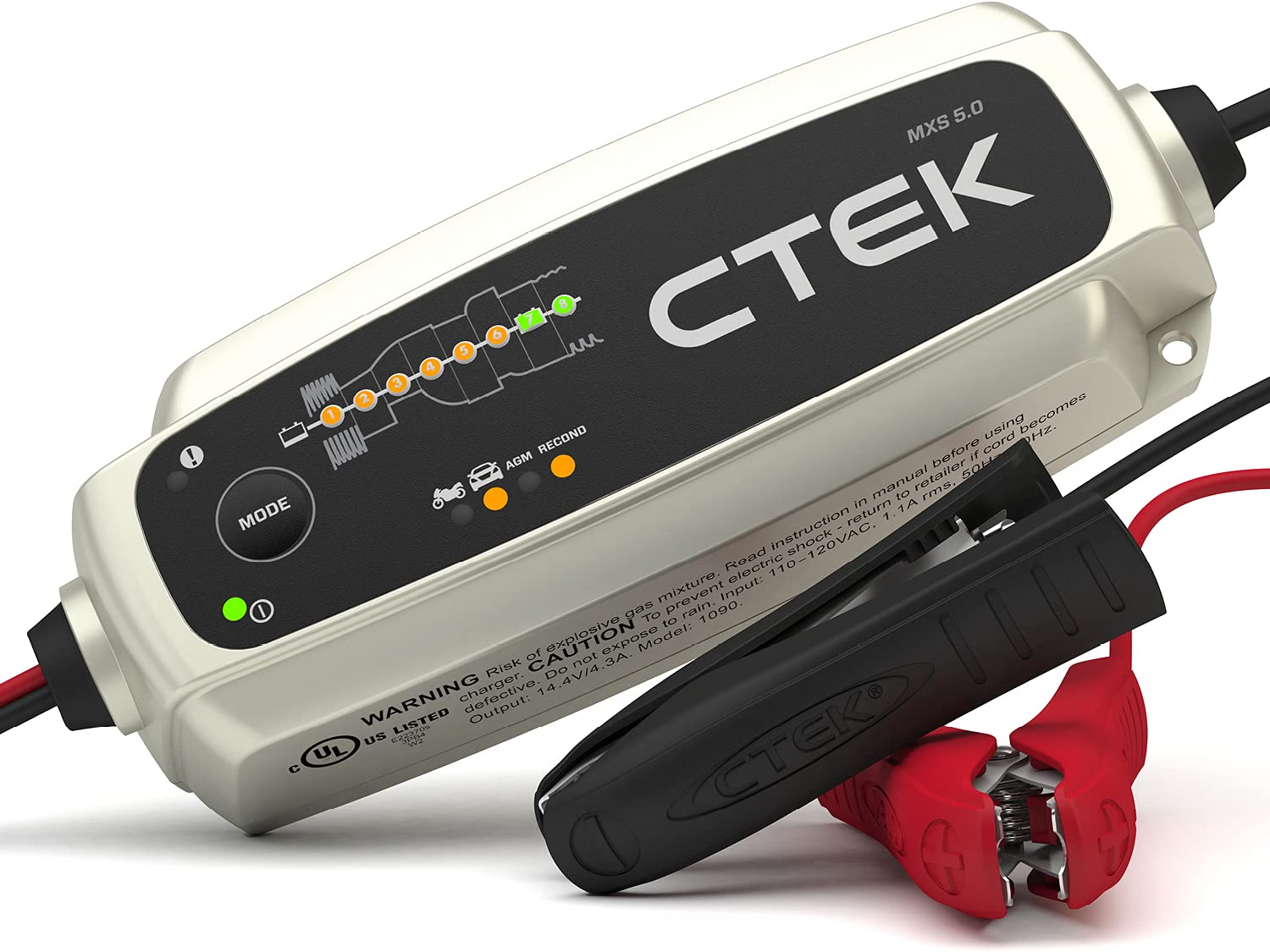
| CTEK MXS 5.0 | Best Premium | 4.3A, temp compensation, Recond | $$$ | Check price |
| NOCO GENIUS10 | Best for PowerBoost & Dual Battery | 10A, 6V/12V, lithium-capable | $$$ | Check price |
1. Battery Tender Plus 1.25A — Best Overall
The Plus is the boring, correct answer. It charges at 1.25 amps, switches to a true float at 13.2V, and will sit on an F-150 battery for six months without cooking it. On my truck the ring-terminal pigtail runs from the battery down behind the driver’s side headlight and tucks into the grille, so plugging in means opening nothing.
- Genuine float (not a pulse-and-hope timer), so it’s safe to leave connected all winter.
- Comes with both alligator clips and a ring-terminal harness — use the harness on an F-150 so you’re not fighting the crowded negative post every time.
- Deltran still honours a long warranty and the units genuinely last a decade.
- Handles the group 65 flooded batteries in 2009–2020 trucks without any mode switching.
Honest cons: there’s no AGM-specific mode, so on a stop-start truck the absorption voltage runs a touch low for a factory AGM — it maintains fine but won’t fully recover a deeply drained one. And 1.25A is a maintainer, not a charger: F-150 owners on f150forum report that a 1–1.3A unit will not pull an already-flat installed battery up to float, because the truck’s modules are drawing current the whole time.
Buy it if your F-150 is a 2009–2020 non-stop-start truck that sits for weeks at a time and you want one device that just works.
Check the current price on Amazon
2. Battery Tender Junior 750mA — Best Budget
The Junior is the same brain in a smaller box at roughly half the price. It’s the unit the original poster in that f150forum thread switched to after a 1-amp competitor threw a battery fault, and it brought his AGM back up overnight.
- Cheapest genuinely safe long-term maintainer I’d put on a truck.
- No mode switch to get wrong — it runs one profile that is gentle enough for both flooded and AGM.
Honest cons: 750mA is strictly top-up duty; if your F-150 has been sitting three months on a dying battery this will spin its wheels for days. It also has a short lead, so plan on an extension cord.
Buy it if you’re maintaining a second truck, a plow truck, or you just want insurance on a healthy battery.
Check the current price on Amazon
3. NOCO GENIUS2D 2A Direct-Mount — Best Permanent Install
This is the pick F-150 owners keep arriving at on their own. The 2D is a sealed, direct-mount charger designed to bolt down and stay in the truck — two separate owners in the gen-13 thread run one permanently, and a Lightning owner mounted a NOCO on the back of the battery access door wired to a weatherproof 120V inlet in the grille.
- Potted and weatherproof, so it lives under the hood year-round without corroding.
- Real AGM and lithium modes, plus temperature compensation — important because the F-150’s battery sits right behind the grille where winter air hits it.
- 2A is enough to actually make progress against the truck’s parasitic draw, unlike a 750mA unit.
- Removes the single biggest annoyance on an F-150: you never clamp onto that crowded negative post again.
Honest cons: it’s a one-hour install with a fused positive lead and a chassis ground, not a plug-and-play box — and NOCO uses its own connector, so you’ll want an SAE adapter if you already own other pigtails.
Buy it if the truck is stored, a seasonal vehicle, or a Lightning whose 12V you want topped up without opening the frunk.
Check the current price on Amazon
4. NOCO GENIUS5 5A — Best for AGM Stop-Start F-150s
If your truck has Auto Start-Stop — most 2015-and-up F-150s, and every PowerBoost — the factory battery is an AGM, and AGMs want a higher absorption voltage than a plain tender delivers. The GENIUS5 has a dedicated AGM mode and enough current to recover a battery, not just hold one.
- 5A recovers a drained AGM in a day instead of a week.
- Force mode will start charging a battery that’s fallen so low a normal charger refuses to see it — common on an F-150 left two months with the FordPass modem awake.
- Repair/desulfation mode that genuinely helps a sulfated battery that’s been sitting.
Honest cons: NOCO’s small units have a real reputation for throwing a battery-fault LED on F-150s — one owner watched a Genius 1 let the battery sag past 11V overnight. In nearly every case on the forums the cause is a poor ground clamp, not a dead charger; see the hookup note below. The buttons are also fiddly in gloves, and it loses its mode selection on a power cut.
Buy it if your F-150 has stop-start, an AGM battery, or a battery that’s already somewhat down.
Check the current price on Amazon
5. CTEK MXS 5.0 — Best Premium
The CTEK is what I’d buy if the truck is a keeper. 4.3A, eight stages, ambient temperature compensation and a Recond mode that will claw back a stratified battery. It’s the unit European dealers hand out with their own storage kits.
- Temperature compensation actually matters on an F-150: the battery is in the airflow behind the grille, and a flat-voltage charger overcharges it in July and undercharges it in January.
- Recond cycle revives stratified flooded batteries that a plain float won’t touch.
Honest cons: it’s roughly double the price of the Battery Tender Plus for a marginal real-world gain on a work truck, and the single-button interface takes a read of the manual to understand. Recond also should not be run with the battery connected to the truck’s electronics.
Buy it if you’ve got a garage-kept F-150 you intend to own for ten years, or you’re maintaining several vehicles and want one good charger.
Check the current price on Amazon
6. NOCO GENIUS10 10A — Best for PowerBoost and Dual-Battery Trucks
If you’ve added a second battery for a camper, a winch or a Pro Power Onboard setup, 1–2 amps won’t keep up. The GENIUS10 pushes 10A, handles 6V and 12V, and will charge lithium as well as AGM — which matters if your auxiliary battery is a LiFePO4 house bank.
- 10A will actually recharge a pair of group 65 AGMs overnight.
- Covers lead-acid, AGM, EFB and lithium, so one unit handles both batteries in a dual setup.
Honest cons: overkill — and arguably unkind — on a single healthy battery you only want to maintain; it is a charger first and a maintainer second. It’s also physically big and runs warm.
Buy it if you run dual batteries, a PowerBoost with heavy accessory load, or a diesel-style high-capacity setup.
Check the current price on Amazon
How I Picked the Best Battery Maintainer for a Ford F-150
Find the battery first. On every gas F-150 from 2009 through 2026 it’s under the hood in the driver’s side front corner, usually a group 65. Stop-start and PowerBoost trucks get an AGM version of the same group. On the Lightning the 12V lives under the frunk floor behind an access panel.
Then get the negative lead right — this is the whole ball game. Ford clamps a battery monitoring sensor onto the negative post. If you clip your maintainer’s black lead to the battery’s negative terminal above that sensor, the truck’s charging logic never counts the current you’re feeding in, and on newer trucks it will keep running its own charge strategy against you. Clamp the negative to a clean chassis or engine ground instead, downstream of the sensor. Lightning owners wiring a permanent SAE pigtail say the same thing: ground below the sensor, because the truck coulomb-counts state of charge.
Match the chemistry. AGM mode is not marketing. A tender without it will hold an AGM at a voltage that slowly undercharges it.
Size the amps to the job. Under 1A is maintain-only. 2A is the sweet spot for a truck with modules that never fully sleep. 5A if the battery is already down; 10A for dual batteries.
Permanent beats portable on a truck. If you’ll be plugging in more than a few times a year, a direct-mount unit and a pigtail routed to the grille pays for itself in skinned knuckles.
FAQ
Can I leave a battery maintainer on my F-150 all the time?
Yes, if it has a true float stage — the Battery Tender Plus, CTEK and NOCO units here all do. A genuine maintainer drops to around 13.2V and holds there indefinitely. What you should not leave connected is an old unregulated trickle charger, which will boil a battery dry over a few months.
What’s the difference between a trickle charger and a battery maintainer?
A trickle charger pushes a fixed small current and never stops. A maintainer monitors voltage, charges, then floats. On an F-150 with an AGM battery the difference is a battery that lasts six years versus one that lasts two.
Will a battery maintainer charge a dead F-150 battery?
Usually not. A 750mA–1.25A unit is fighting the truck’s own parasitic draw, so it can sit for days without reaching float — F-150 owners run into this constantly. Use a 5A charger like the GENIUS5, or disconnect the battery from the truck before charging. If it won’t hold a charge after that, it’s a battery problem, and you want a jump starter in the toolbox until you replace it.
Why does my F-150 battery go dead when it sits for two weeks?
Modern F-150s have a lot of modules that wake up — the telematics modem, SYNC, keyless entry, and anything you’ve hardwired like a dash cam in parking mode. A healthy battery tolerates it; a three-year-old one doesn’t. Two weeks of standing is right at the edge for a stock truck.
Does the F-150 Lightning maintain its own 12V battery when plugged in?
Not reliably. Lightning owners report the truck only tops up the 12V while the high-voltage pack is actively charging, not simply because it’s plugged into a Level 2 charger. Ford’s own guidance for storage past 30 days is to leave the pack near 50% and disconnect or periodically top up the 12V — which is exactly why a direct-mount maintainer makes sense on a Lightning.
Verdict
For most F-150 owners the Battery Tender Plus 1.25A is the right buy: a true float, a ring-terminal pigtail you can route to the grille, and a decade of service life. On a budget, the Battery Tender Junior does the same job on a healthy battery for about half the money. If your truck has stop-start and an AGM, step up to the NOCO GENIUS5; if it’s stored, seasonal, or a Lightning, install the NOCO GENIUS2D and stop opening the hood. Whichever you pick, ground the negative lead to the chassis below Ford’s battery sensor — that one detail is the difference between a maintainer that works and a fault light.
Related guides
- Best Battery Maintainers & Trickle Chargers for Lexus RX (2026)
- Best Jump Starters for the Ford F-150 (EcoBoost, 5.0L V8 & PowerBoost)
- Best Dash Cams for the Ford F-150 (Hardwire Guide & Gen-14 Fit)
- Best Portable Jump Starters for SUVs: Tested Picks for 2026