If you drive a 4Runner, the dead-battery conversation usually ends the same way: the stock Group 24F battery is rated at a modest 530 cold-cranking amps, the 4.0L 1GR-FE is a willing but thirsty starter in the cold, and sooner or later you are standing in a parking lot waiting on a stranger with cables. I have carried a pack in the back of mine for years. The best jump starter for a Toyota 4Runner, for most owners, is the NOCO Boost HD GB70 — 2,000 amps gives real headroom over the 4.0L’s actual crank draw, and it still has enough left to help someone else. Below are five packs I would actually put in a 4Runner, plus the part nobody explains well: where you clamp on, which changes completely if you have a 2025-or-newer hybrid.
As an Amazon Associate, Top10Great earns from qualifying purchases. This post contains affiliate links, which means we may receive a commission if you buy through our links, at no extra cost to you.
Best Jump Starter for Toyota 4Runner: Quick Comparison
| Model | Best for | Key spec | Price | Link |
|---|---|---|---|---|
| NOCO Boost HD GB70 | Best overall | 2,000A peak, up to 8.0L gas | $$ | Check price |
| GOOLOO GP4000 | Best budget | 4,000A peak, 24,000mAh | $ | Check price |
| NOCO Boost X GBX55 | Best premium | 1,750A, 60W USB-C in/out | $$$ | Check price |
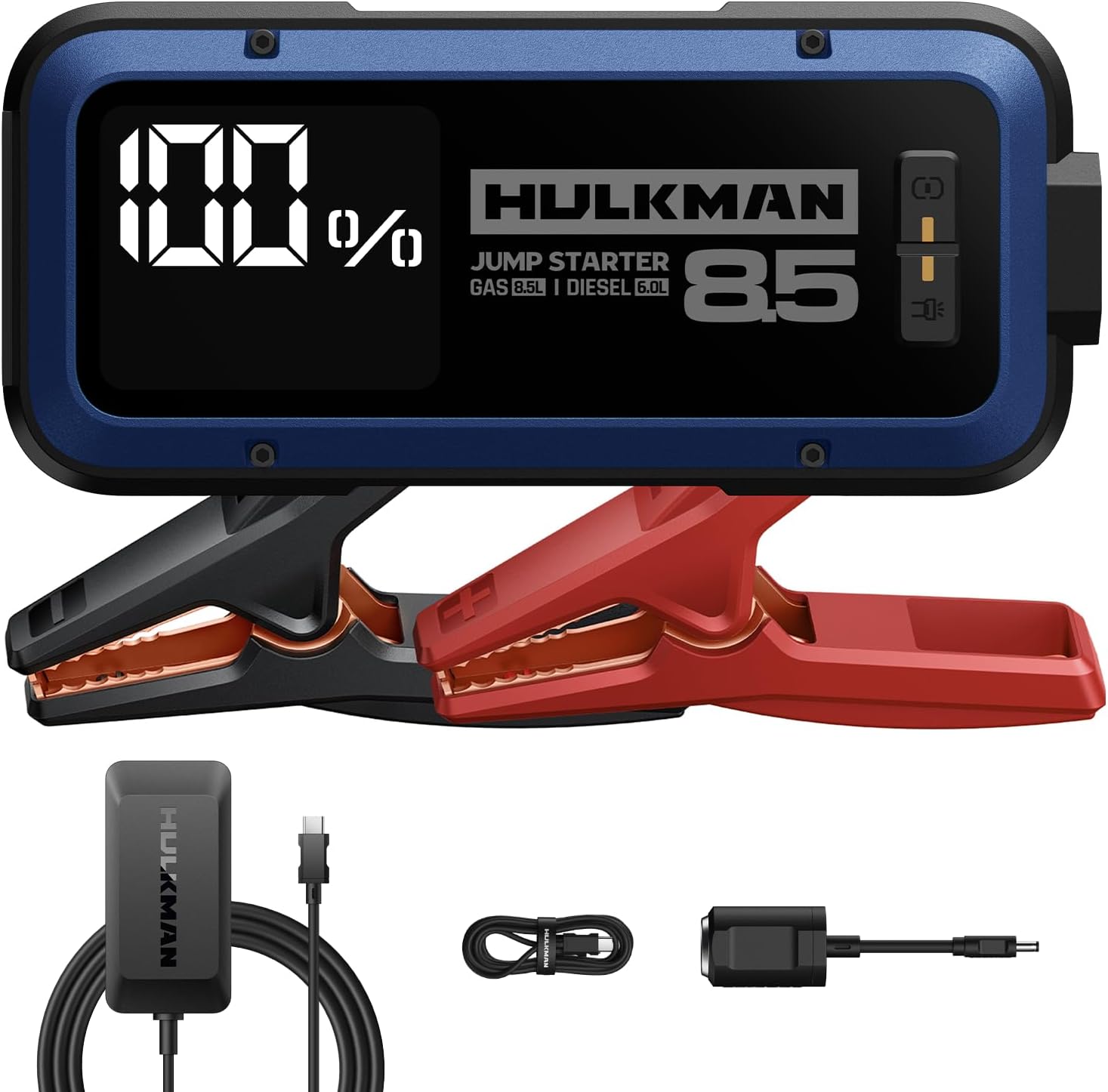
| HULKMAN Alpha 85 | Deep cold | 2,000A, self-heating cells | $$ | Check price |
| NOCO Boost Plus GB40 | Compact / glovebox | 1,000A peak, 8,000mAh | $ | Check price |
Where the Battery Actually Is — and Why 2025 Changed Everything
Get this part right before you buy anything, because it decides how long a cable you need.
5th gen, 2010–2024 (4.0L 1GR-FE). The battery sits on the driver’s side of the engine bay, tucked just behind the driver-side headlight housing and forward of the fuse box. The positive post wears a black plastic flip-up cover; pull it back and you have clean access. The hold-down bar runs on two 10mm nuts with J-hooks front and rear of the tray, so if you are replacing rather than jumping, a deep 10mm socket on a 1/4″ drive is the whole job. Clamps reach both posts easily here — any pack with standard-length leads works.
6th gen, 2025+, gas 2.4L turbo. The 12V battery moved to the passenger side of the engine bay. Toyota specs a Type C (LN4) battery, 75Ah or greater, 776 CCA or greater, and on Stop & Start trucks it wants a Toyota-approved battery — worth knowing before you buy a cheap replacement and start chasing stop/start faults.
6th gen i-FORCE MAX hybrid — read this twice. There is no 12V battery under the hood. The starter battery was relocated to the rear cargo area, driver’s side, behind the rear wheel, held in by a bracket on four 12mm bolts (a 13mm deep socket gets the terminal). Owners open the hood, find no battery, and assume something is badly wrong. Nothing is wrong. You jump the hybrid at the engine-bay fuse box on the passenger side: pop the fuse box cover off, and you will see a red cover over the positive terminal. Flip it open and clamp there.
For ground on any 6th gen, Toyota points you at a specific metal point illustrated on pages 608–609 of the owner’s manual. If your clamps are too fat for it, 4Runner owners use one of the 12mm bolts along the inner fender wall, or — the better bet for big jaws — the 17mm chassis ground bolt under the air intake inlet cover.
One 6th-gen quirk that trips people up: the smart key has to be inside the vehicle, and after you connect the pack you leave the engine switch OFF, open and close a door, and then hit the start button. The 4Runner also cannot be push-started, hybrid or not.
The Five Picks
1. NOCO Boost HD GB70 — Best Overall
A 2,000-amp lithium pack rated for gas engines up to 8.0L, which is comfortable overkill for a 4.0L V6 — and overkill is the point. Trail4Runner’s own testing puts a 4Runner’s need at a minimum of 700–800 amps and ideally 1,000; buying double that means the pack still starts the truck when it is half-charged and the thermometer says 10°F.
Pros:
- 2,000A peak with genuine margin over the 1GR-FE’s crank draw, so it works at partial charge
- Heavy 8-gauge clamps that bite the 5th gen’s exposed posts properly
- Reverse-polarity and spark-proof protection — relevant when you are reaching blind into a 6th gen fuse box
- Enough capacity left over to start a second vehicle on the same charge
Cons:
- Still charges over micro-USB, which is slow and feels dated at this price
- Owners report charge-retention problems — packs found flat after a few months in storage, which is the most common NOCO complaint across forums and review sites
Buy it if you want one pack that will not leave you guessing. Check current price
2. GOOLOO GP4000 — Best Budget
Typically $70–85 and frequently discounted below that, with a 24,000mAh cell — three times the GB70’s capacity — and a claimed 4,000A peak. The capacity is the real story: it means multiple start attempts on a cold morning without recharging, which matters more on a 4Runner than raw peak numbers do.
Pros:
- Roughly a third the price of the NOCO for similar real-world results on a V6
- 24,000mAh gives far more attempts per charge than the 8,000mAh NOCO packs
- Doubles as a usable power bank for a trail weekend
- Built-in light and a clear charge display
Cons:
- Treat the 4,000A figure as marketing — peak amps are a momentary burst, not sustained output, and budget brands quote it generously
- Clamps and case feel cheaper than the NOCO’s; the leads are shorter than I would like for reaching a 6th gen fuse box
Buy it if you want insurance in the cargo area and would rather not spend $200. Check current price
3. NOCO Boost X GBX55 — Best Premium
The Boost X line is NOCO’s answer to the micro-USB complaint: 60W USB-C in and out, so it refills in about an hour. 1,750 amps is less peak than the GB70 but still well clear of what a 1GR-FE asks for.
Pros:
- 60W USB-C recharging — about an hour to full instead of most of a day
- Works as a serious power bank, which earns its space on a camping trip
- Best build quality in this group
- Same spark-proof and reverse-polarity protection as the rest of the NOCO range
Cons:
- Costs about the same as the GB70 for fewer peak amps
- Scattered owner reports of GBX units refusing to accept a charge after light use — the failure mode to watch on this model
Buy it if the recharge speed and the USB-C dual duty matter to you. Check current price
4. HULKMAN Alpha 85 — Best for Deep Cold
Lithium packs lose output as they get cold, which is exactly when you need them. The Alpha 85 warms its own cells before delivering current, and that is the single most useful feature on this page if you park outside in a northern winter. 2,000A, 20,000mAh, and the highest owner ratings in the group.
Pros:
- Self-heating cells, so the pack performs when a cold GB40 would sag
- 2,000A with 20,000mAh — power and capacity, not a trade-off between them
- Large, genuinely readable display showing state of charge and battery voltage
- Consistently the best-rated pack in this set among long-term owners
Cons:
- Price swings hard — around $100 on sale, closer to $190 at list, and it has spiked higher during cold snaps
- Physically bulky; this is a cargo-area pack, not a glovebox one
Buy it if your 4Runner lives outside somewhere that sees single digits. Check current price
5. NOCO Boost Plus GB40 — Best Compact
1,000 amps, 8,000mAh, and small enough to actually live in the vehicle instead of the garage. This is the pack Trail4Runner calls adequate for a 4Runner on its own, and for a mild climate that is a fair call.
Pros:
- Genuinely compact — fits a glovebox or door pocket, so it is there when you need it
- 1,000A hits the number owners actually recommend for the 4.0L
- Cheapest route into the NOCO safety features and clamp quality
- Enormous owner base, so its behaviour is well documented
Cons:
- 1,000A is the floor, not a cushion — in deep cold with a tired 24F battery it can run out of talent
- Micro-USB charging, around six hours from flat
Buy it if you want something small and will top it up regularly. Check current price
How to Choose: What Actually Matters
Peak amps are not cranking amps. The big number on the box is a momentary burst measured in ideal conditions. Engine-size ratings assume a fully charged pack at about 70°F. Buy roughly double what you think you need and you have covered the gap between the lab and your driveway. For the 4.0L V6, that means 1,000A as an absolute floor and 2,000A if you want to stop thinking about it.
Capacity decides how many tries you get. Peak amps govern whether one attempt works; mAh governs how many attempts you have. An 8,000mAh pack is fine for a single confident start. A 20,000–24,000mAh pack is what you want if the truck is going to crank, almost catch, and die three times first.
Cold kills lithium output. Every pack here loses punch below freezing. Only the Alpha 85 does anything about it. If you are in a mild climate, ignore this; if you are not, it is the deciding factor.
Recharge input. Micro-USB means six hours and a cable you have stopped owning. USB-C PD means an hour. The pack you can top up easily is the pack that is actually charged.
Clamp jaws and lead length. On a 5th gen with exposed posts, anything works. On a 6th gen, and especially the hybrid, you are clamping onto a terminal inside the fuse box and grounding to a fender bolt — short leads and fat jaws make that genuinely awkward. Check cable length before you buy.
Self-discharge. Lithium cells drain in storage, and leaving one fully flat for months can permanently damage them. Put a reminder in your phone and top the pack up every three months. This is the most common reason a jump starter fails the one time you need it.
FAQ
How many amps do I need to jump start a Toyota 4Runner?
Plan on 1,000 peak amps as a minimum for the 4.0L V6, and 2,000 if you want margin for cold weather or a partially charged pack. Owner consensus puts the real requirement around 700–800 amps in good conditions.
Where is the battery on a Toyota 4Runner?
On 2010–2024 models it is in the engine bay on the driver’s side, behind the headlight. On 2025+ gas models it moved to the passenger side. On the 2025+ i-FORCE MAX hybrid there is no battery under the hood at all — it is in the rear cargo area on the driver’s side.
Can you jump start a 2025 4Runner hybrid with a portable jump starter?
Yes, and you do not touch the hybrid system to do it. Clamp the positive to the terminal under the red cover inside the passenger-side engine-bay fuse box, ground to the point Toyota illustrates in the manual, keep the smart key inside, then open and close a door before pressing start.
Will a 1,000-amp jump starter work on a 4Runner in cold weather?
Often, but it is the pack most likely to disappoint you. A 1,000A unit at full charge in 40°F weather is fine; the same unit at 60% charge in 5°F weather, against a weak 530 CCA battery, may not be.
Why does my 4Runner battery keep dying?
The stock Group 24F Panasonic is rated at only 530 CCA, which is modest for the 4.0L, and it ages badly in heat. Many owners move to an AGM — the Odyssey 34R-PC1500T at 850 CCA fits with the stock cables (sometimes with a spacer), while Group 31 options like the NorthStar or Odyssey 31-PC2150S at 1,150 CCA need terminal extensions to clear.
The Verdict
The NOCO Boost HD GB70 is the pack I would put in a 4Runner and stop thinking about: 2,000 amps is real margin over what the 1GR-FE asks for, the clamps are serious, and it will start your neighbour’s truck too. If the price stings, the GOOLOO GP4000 at around $70–85 gives you three times the capacity for a third of the money, and on a V6 you are unlikely to ever notice the difference in build quality. Park outside in a real winter and spend the money on the HULKMAN Alpha 85 instead — self-heating cells are worth more in January than another 500 peak amps on paper.
Related guides
- Best Jump Starters for the Toyota Tundra (5.7L & 3.4L V6 Tested Picks)
- Best OBD2 Scanners for the Toyota 4Runner (Generation-by-Generation Picks)
- Best Portable Jump Starters for SUVs: Tested Picks for 2026
- Best Battery Maintainers & Trickle Chargers for Lexus RX