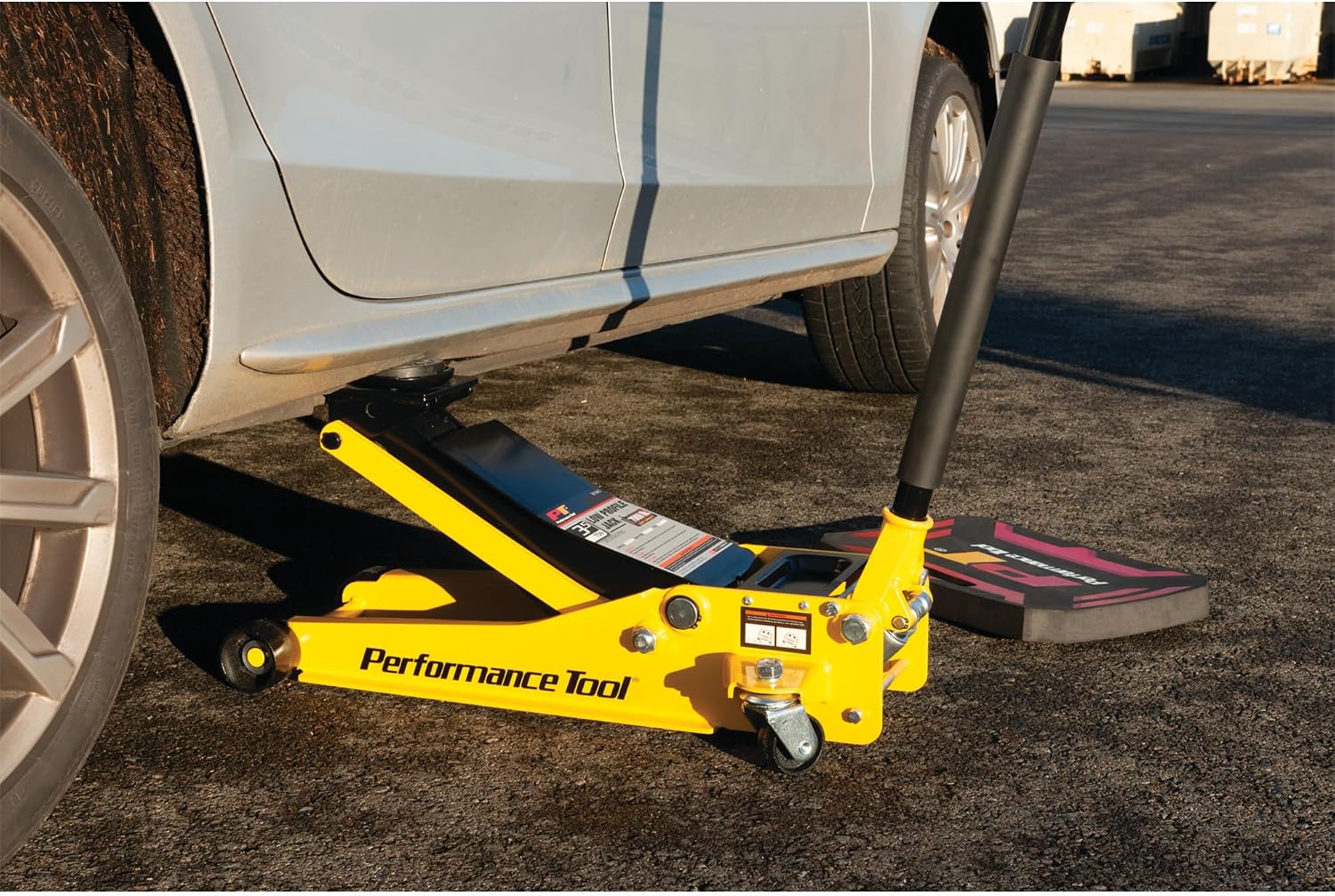
The short answer: the best floor jack for Ford F150 owners is the Performance Tool W1645 3.5-Ton, because it lifts to 20.5 inches and that number matters far more on this truck than the low-profile spec everyone obsesses over. I’ve spent a lot of Saturdays under half-ton trucks, and the mistake I see most often is a guy buying a slick 2-ton racing jack for a 5,000-pound truck, then finding it tops out two inches short of the frame rail with the suspension hanging. This guide is for F-150 owners who want to rotate their own tires, do their own brakes, and get a stand under the truck safely — stock, levelled, or on 35s.
As an Amazon Associate, Top10Great earns from qualifying purchases. This post contains affiliate links, which means we may receive a commission if you buy through our links, at no extra cost to you.
Quick comparison
| Jack | Best for | Key spec | Price | Link |
|---|---|---|---|---|
| Performance Tool W1645 3.5-Ton | Best overall | 3.5″ – 20.5″ lift, dual piston | $$ | Amazon |
| BIG RED T83006 Torin 3-Ton | Best budget | Up to ~20.9″ with extra saddle | $$ | Amazon |
| Arcan A20019 3-Ton Aluminum | Best premium | 3.75″ – 18″, ~56 lb | $$$ | Amazon |
| Powerbuilt 620471 Unijack | Levelled & lifted trucks | 11″ – 21″, jack + stand in one | $ | Amazon |
| BIG RED T46002A 6-Ton stands | The stands you actually need | 12,000 lb pair, tall enough for a frame rail | $ | Amazon |
The best floor jack for Ford F150 trucks is the tallest one, not the lowest
Every roundup ranking for this search sells you on low-profile height. One recommends a 2-ton trolley kit with a 13-inch maximum lift as its budget pick, then admits in its own verdict that it “lacks capacity and lift for heavier truck work.” That’s the whole problem in one sentence.
A 2025 F-150 XLT SuperCrew 4WD has 9.8 inches of ground clearance, per Edmunds; a Raptor has 12.0. You don’t need a 2.8-inch saddle to slide under that. You need travel at the top, because the moment you lift one corner of a body-on-frame truck, that corner’s suspension droops and the frame rail climbs away from you. The practical target is 16 to 18 inches of lift at the jack point just to fit a stand underneath — and the 6-ton stands this truck wants start around 15 inches tall.
Capacity is the second thing competitors get wrong. That same XLT SuperCrew weighs 4,941 pounds at the curb against a 6,650-pound GVWR; a Limited SuperCrew 4WD runs closer to 5,950, and the heaviest-payload trucks carry a GVWR up to 7,850. The front axle takes roughly 60 percent of that, so lifting the front crossmember of a loaded truck can put around 4,700 pounds on the saddle. A 2-ton jack is rated for 4,000. Three tons is the floor for an F-150.
F150 jack points: where the arrow actually is
None of the ranking articles will tell you this, and it’s printed in your own manual. The 2021-and-later F-150 manual says to use the frame rail as the front jacking point, not the control arm — and an arrow is stamped on the rail marking the exact spot, just behind the front wheel well. On 2015-and-newer aluminum-bodied trucks the frame carries reinforced, marked jack pads for this reason, and some trucks have a lift-point decal on the firewall.
Front: the boxed frame rail behind the front wheel, jack perpendicular to the rail, or the centre of the front crossmember if you want both wheels up. Never the lower control arm — it swings through an arc as the suspension unloads and the saddle walks off it.
Rear: the solid axle tube next to the leaf spring perch, or the frame rail just forward of the rear shackle. You can lift from the differential housing, but the centre of the axle risks damaging the stamped differential cover, and the OEM scissor jack is not rated for it at all.
One warning that is pure F-150 and that I have never seen in a floor jack review: if your truck has power running boards, turn them off before jacking it up or crawling under it. The manual says not to lift on the running boards, the hinge assemblies, the board motors or their underbody mounts — and those mounts sit exactly where you’d slide a jack in from the side.
Performance Tool W1645 3.5-Ton — best overall
A 3.5-ton steel service jack with a dual-piston pump and swiveling saddle, 3.5 to 20.5 inches.
- That 20.5-inch maximum clears a stock F-150 frame rail with the suspension fully drooped and still leaves room for a 6-ton stand.
- 3.5 tons keeps you well clear of the rating lifting the front crossmember of a loaded SuperCrew.
- Dual pistons and long chassis reach: working height in a few strokes, and you can reach the crossmember without parking under the bumper.
Cons: published specs are inconsistent — NAPA’s listing quotes the minimum saddle height as 3-1/2 inches in one place and 3-5/8 in another. And it’s steel: heavy to drag across a garage floor, not something for the bed.
Buy it if you want one jack for the F-150 and everything else in the driveway. Check the price on Amazon.
BIG RED T83006 Torin 3-Ton — best budget 3 ton floor jack for a truck
Amazon’s listing title for this one says “Fits: SUVs and Extended Height Trucks,” which for once is accurate: it reaches about 20.9 inches with the supplied extra saddle fitted.
- Roughly the same usable lift height as jacks costing twice as much.
- The screw-on saddle extension is the whole trick — it’s what turns an ordinary 3-ton trolley jack into something that reaches an F-150 frame rail.
- Steel, widely stocked and cheap to replace — an advantage for a tool that lives on a concrete floor.
Cons: quality control on arrival is the recurring complaint — Walmart’s reviews for the same jack sit at 4.4 out of 5 across 52 reviews, the one- and two-star ones reporting a missing saddle, a missing handle, and a unit that arrived looking used. Inspect yours. And with the extension fitted the minimum height rises to around nine inches, so it stops being low-profile at all.
Buy it if you want real lift height cheap and will inspect it on arrival. Check the price on Amazon.
Arcan A20019 3-Ton Aluminum — best premium
The quick-rise aluminium jack most forum regulars end up buying: 3.75 to 18 inches, dual pistons, around 56 pounds, and 4.6 out of 5 across 113 reviews on Home Depot’s listing.
- Half the weight of a comparable steel jack, which you notice every time you move it.
- Full height in four or five pumps; side-mount handle that doesn’t foul the rocker panel.
- The one here you’d happily use on a low car as well as the truck.
Cons: 18 inches is the shortest maximum lift here, a genuine limitation — on a levelled F-150 it often runs out of travel before a 6-ton stand will fit. Owners also report the hydraulics weeping if it’s left loaded, so get the truck onto stands and lower the jack rather than leaving it holding weight.
Buy it if your truck is stock and you value the light weight; if it’s levelled, buy the W1645. Check the price on Amazon.
Powerbuilt 620471 Unijack — the floor jack for a lifted F150 problem
Not a trolley jack: a 3-ton bottle jack inside a wide locking stand, roughly 11 to 21 inches.
- It starts at 11 inches, which is the point — on a levelled truck on 33s or 35s a conventional jack’s saddle is already below the frame at full extension, and this one begins where they finish.
- It locks mechanically, so the thing that lifted the truck also holds it: one fewer transfer, one fewer chance to get it wrong.
- Wide footprint, far more stable than a bare bottle jack, and cheap enough to own a pair.
Cons: that 11-inch minimum makes it useless on anything low — it won’t fit under a stock car, and at a stock F-150’s rear jack point it can be marginal. On asphalt or gravel owners report it feeling tippy; put a steel plate under it.
Buy it if your truck is levelled and your jack stopped reaching. Check the price on Amazon.
BIG RED T46002A 6-Ton jack stands — buy these, not 3-ton stands
A pair of double-locking steel stands, 6 tons (12,000 lb) for the pair.
- Tall enough to actually reach an F-150 frame rail — common 3-ton stands top out near 16 inches and frequently won’t make contact once the suspension has drooped.
- Double-locking: a ratchet plus a pin, so one failure doesn’t drop the truck.
- Big saddles that sit properly on a boxed frame rail, and cheap relative to everything else here — the component you least want to economise on.
Cons: heavy, and the minimum height makes them overkill if you also want stands for a car. Published height ranges vary between BIG RED’s own listings, so measure where your frame rail sits first.
Buy them if you’re getting under the truck at all. Check the price on Amazon.
What actually matters when choosing an F-150 floor jack
Maximum lift height first. Look for 20 inches or more on a stock truck, and treat 18 as the absolute minimum. If it’s levelled or on larger tires, a conventional trolley jack may not be the right tool at all — that’s what the Unijack is doing here.
Capacity second, 3 tons minimum. Size the jack to about one and a half times the load it will actually carry. Front-axle load on a loaded F-150 approaches 4,700 pounds, so a 2-ton is over its rating before you start, and jacks run near their limit are the ones that fail.
Saddle reach, not saddle height. What matters on a truck is how far the arm extends from the wheels, because the front crossmember sits well inboard. Look for 24 inches of reach or more. Minimum saddle height is close to irrelevant at 9.8 inches of clearance.
Stands are not the place to save money. Buy 6-ton stands, set them under the frame rails behind the front wheels and ahead of the rear wheels, inboard of the rocker, and chock the wheels still on the ground. A hydraulic jack is a lifting device, not a holding device.
One last check: find the arrow on your own frame rail before you order, and look at how much room there is to slide a jack in from the side. With power running boards, that gap is smaller than you think.
Frequently asked questions
What size floor jack do I need for an F-150?
A 3-ton (6,000 lb) jack is the minimum; 4-ton if you also work on heavier trucks. A 2-ton is undersized — the front axle of a loaded F-150 can put roughly 4,700 pounds on the saddle, and a 2-ton is rated for 4,000.
Where are the jack points on a Ford F-150?
Front: the frame rail just behind the front wheel — there’s an arrow stamped on the rail marking it — or the centre of the front crossmember. Rear: the axle tube beside the leaf spring perch, or the frame rail ahead of the rear shackle. The 2021+ manual is explicit that the front point is the frame rail and not the control arm.
Can I use a low-profile floor jack on an F-150?
Yes, but it solves a problem you don’t have. At 9.8 inches of ground clearance, getting under the truck is never the constraint — maximum lift height is. Buy the jack that goes highest, not the one that starts lowest.
Is it safe to jack up an F-150 by the rear differential?
A properly rated floor jack on the differential housing lifts the rear evenly, but lifting at the centre of the axle risks damaging the stamped differential cover, and the OEM scissor jack must never be used there. The axle tube beside the spring perch is the better contact point.
What size jack stands do I need for an F-150?
Six-ton stands — and height, not capacity, is the reason. Three-ton stands commonly top out near 16 inches and often won’t reach an F-150’s frame rail once that corner has drooped.
The verdict
The Performance Tool W1645 3.5-Ton wins for one reason that outweighs its whole spec sheet: 20.5 inches of lift, with capacity to spare. On a budget, the BIG RED T83006 reaches nearly the same height with its saddle extension for well under half the money — just inspect it on arrival. If your truck is levelled, skip both and get the Powerbuilt Unijack. Whichever you choose, put 6-ton stands under the frame rails before any part of you goes under that truck.
Related guides
- Best Floor Jacks for the Chevy Silverado 1500 (Lift Points & 2500HD Notes)
- Best Jump Starters for the Ford F-150 (EcoBoost, 5.0L V8 & PowerBoost)
- Best Floor Jacks for the Toyota 4Runner (Lift Height & Jack Points)
- Best Floor Jacks & Jack Stands for SUVs (Safe Picks for Home Garages)